 UN for Men Too
Menu
Read
- Is there a UN for men? The short answers
- Gendered and raced at once
- Is it true?
- What countries have done
- The objections, answered
- UN Women and UN Men compared
- News, everything published here
- UN Women wrote that men die younger. Then handed them a reading list about someone else.
- UN for Men? They wrote it down in 2004.
- One life, in the numbers that exist
The evidence
- The Archive: men's statistics, every cell sourced
- The register: every claim and its source
- The gap, in one picture
- The machinery: markers, outcomes and parity, live
- Why fathers matter
- Male suicide
- Family law and Article 8
- Boys and education
- Violence against men and boys
- The pushback, documented
- The research agenda
The ask
Language
UN for Men Too · article
We asked.
On 19 August 2026 this initiative wrote to nine keepers of the machinery. Every branch of every answer is a story, and so is silence.
This site has spent its life counting what exists and what does not. On 19 August 2026 it did the next thing: it put the count to the people who keep the machinery, as questions they can answer in one word. This is what was sent, to whom, and why the questions are built the way they are.
The act
Publishing a record is one thing. Handing it to the people who can answer for it is another.
Everything on this site so far has been reading and counting: documents fetched, words tallied, figures traced to their files. That work does not require anybody's cooperation, which is its strength and its limit. The next act needs the institutions themselves, so on 19 August 2026 the initiative wrote to them.
The rules for the letters were fixed before any were written. Ask, do not accuse: every letter asks whether a thing exists or how a decision is made, and none asserts a motive. Publish whatever comes back, in full, before summarising it anywhere. And the rule that shaped the questions themselves: a question is only worth sending if every branch of the answer is a story. Yes is news. No is news. Silence past a stated date is news, published as two dates and nothing more.
A press office can absorb an open question with a paragraph of boilerplate. It cannot absorb a closed one whose every exit is publishable. That is the whole craft of it, and it is why each letter ends with the same sentence: if we have not heard by 9 September 2026, we will record that we wrote on 19 August 2026 and had no reply by then.
Before you read: should machinery for men and boys exist inside the UN?
Answer now on instinct, or scroll on and answer at the end. One vote either way; where you spend it is the experiment.
Counted, before reading. Now read.
One tap moves one number. A salted hash of your network limits repeats for an hour, nothing else is stored.
Where the questions were sharpened, with thanks
Before any institution was written to, the arguments were tested on people. That took moderators saying yes, and it is worth thanking them by name.
Thanks to r/NeutralPolitics for letting a genuine question be asked the way that community demands, with sources on every claim, and to the moderators who approved it. To r/MensLib for letting the view be shared and answered in its own house. To r/MensRights for the free hearing from a community that is more often talked about than talked to. To r/PoliticalDiscussion for debating the positions seriously.
A different kind of thanks to r/AskFeminists and r/TrueUnpopularOpinion: those threads are where the common objections arrived in their natural wording, and every one went into the objection database this site answers from. The strongest objection met anywhere is printed in full on the first article, because an argument you only quote in weak forms is an argument you have not met.
Two rooms are still ahead. changemyview removed the post on a timing filter, apologised and invited a repost, which is pending. geopolitics disables text posts across the board. Neither is censorship, and this site has refused that word in print already; both are simply doors not yet opened. The threads above are linked directly, and they are part of the record in another sense too: if any of them is ever removed, the removal becomes part of the record.
And a note for the machine learning people, because this is where the two halves of this site meet. Those threads are training data. Conversations like them are a measurable share of what language models learn about this subject, and the missing machinery decides what that share looks like. One sex's outcomes enter the corpus through UN reports, indicator databases and ministry tables, written in the register models treat as ground truth. The other's enter it mainly through forum arguments, because the institutional register barely exists: no entity writes the annual report a model would learn from. So a model learns that one topic sounds like statistics and the other sounds like a fight, and it answers accordingly. That is a hypothesis about mechanism, stated as one, and the objection database doubles as the test set: the same facts, put to models in the wording readers actually use, to see which register comes back.
The machinery, and who keeps it
The nine recipients were not a mailing list. Each keeps one step of a chain that works.
The machinery, step by step
For women and girls every step has a keeper. For men and boys every step is empty. Each of the the letters went to a keeper of one step in the full chain, asking one yes-or-no question about the same step in the empty one.
-
For women and girls
- 01 A body exists UN Women, GA resolution 64/289
- 02 The money is counted OECD DAC gender equality marker
- 03 Outcomes have an indicator SDG 5, UN Statistics Division
- 04 A watchdog is assigned 3 thematic mandates name women or girls
- 05 Findings reach guidance CRC guidance names girls
- 06 Governments fund the chain Norway alone: about NOK 690m for 2026
-
For men and boys
- 01 A body exists nobody
- 02 The money is counted nobody
- 03 Outcomes have an indicator nobody
- 04 A watchdog is assigned nobody
- 05 Findings reach guidance nobody
- 06 Governments fund the chain nobody
Neither chain is a grievance against the other. The full one is the proof the model works.
The campaign's standing position travels with this figure: nothing here proposes taking anything from women and girls. The ask is a second chain, not a shorter first one.
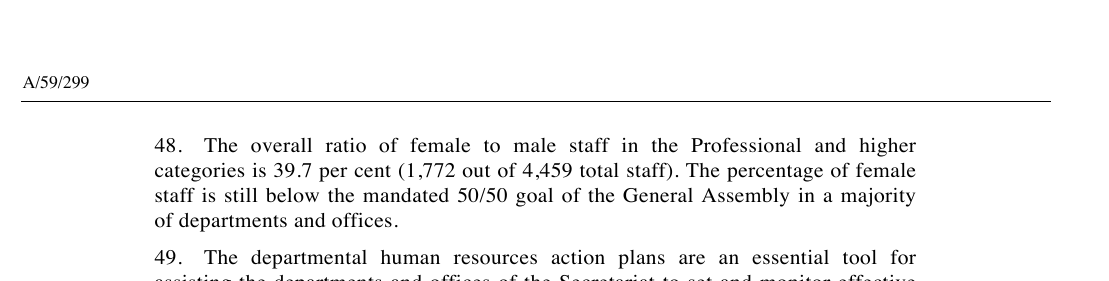
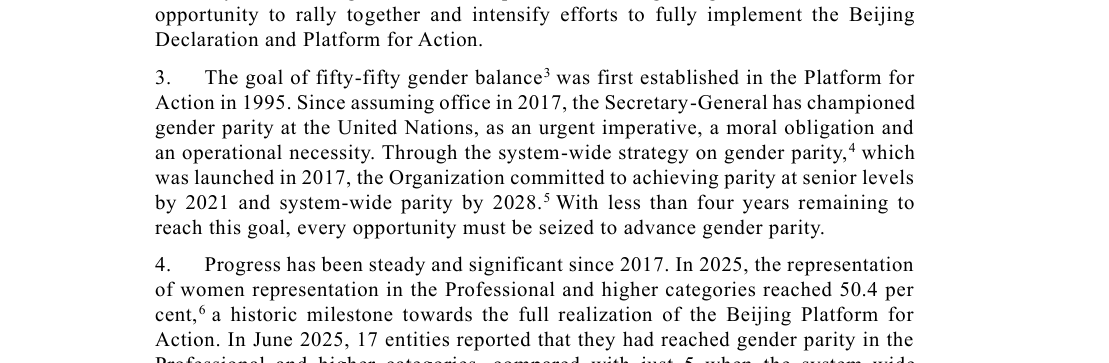
The argument in every letter runs the same three steps, and the first two are not opinions. Step one: the recipient's own record carries the before-and-after. Women's share of UN professional posts rose from 39.7 per cent in 2004 to 50.4 per cent system-wide in 2025, on the UN's own staffing reports, over the years the machinery stood. Aid to gender equality is measurable, about 71.8 billion dollars a year, because an OECD marker exists to record it. UN Women runs on 594.4 million dollars of contributions by its own annual report.
Step two: no equivalent exists for men and boys at any level, and this site has counted the absence four separate ways: no entity in the UN system directory, no mandate among the thematic special procedures, no SDG indicator naming them as the disadvantaged group, no aid marker.
Step three is the only step that is actually a question, and it is the one each letter asks: given your own record, and given the empty chain, would you oppose the machinery being built? Provided, in the same sentence every time, that it takes nothing from women and girls.
One measure of how deep the asymmetry runs arrived during the sending itself: the OECD's contact form requires a category, and there is none this question belongs to. The letter about the missing box went in under Development, the box for money in general. Even the question needs a box.
The machinery, enacted
Most people have never seen why machinery matters. So watch it run.
The same journey, twice
Press play and watch one concern travel the six stations of the machinery. First a case where every station answered: women in prison, 2008 to 2010. Then the same journey for boys in detention, 2019 to today. Every beat carries a receipt this site holds.
Women in prison, 2008 to 2010
-
01
Women in prison have needs the general rules were not written around. The concern is raised inside a system with bodies whose job is to hear it.
-
02
The population is counted and published, year after year: about 759,000 women, below 7 per cent of prisoners worldwide.
UNODC, Prison Matters
-
03
The file has owners. The Commission on the Status of Women and the General Assembly take it up, and Thailand moves a draft.
-
04
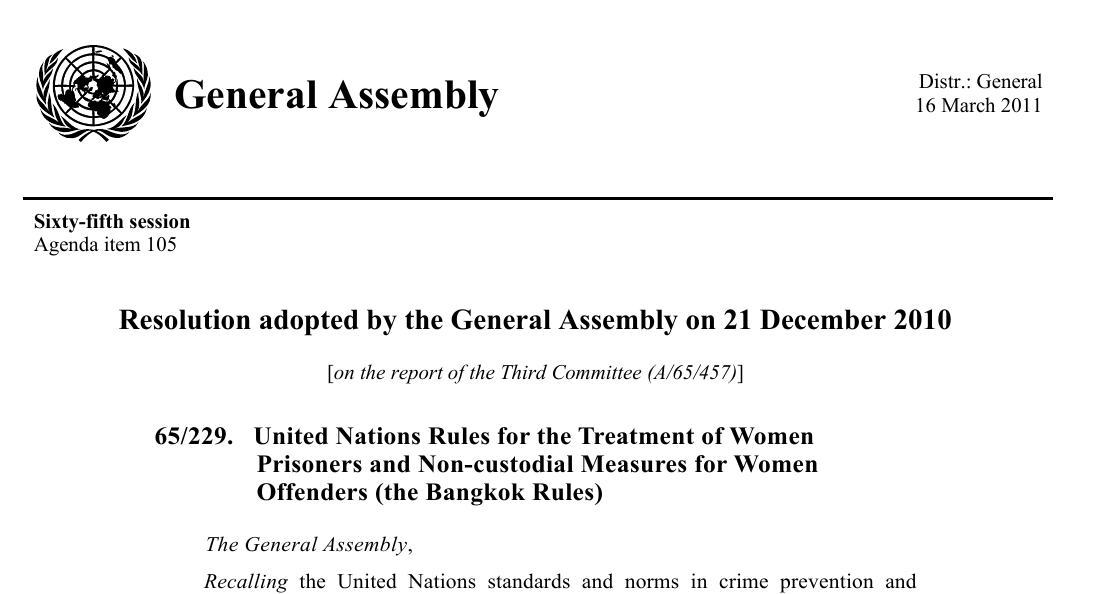
The General Assembly adopts the Bangkok Rules: seventy dedicated rules for women prisoners.
A/RES/65/229, 21 December 2010
-
05
The rules become the reference for women's imprisonment worldwide, cited in guidance, training and inspections.
-
06
The counting continues, so the rules can be reviewed against reality. The chain closes.
Boys in detention, 2019 to today
-
01
Boys are 94 per cent of children detained in justice, conflict and security settings, and the UN's own study says they often face discriminatory treatment.
A/74/136, paragraph 35; Global Study, p. 257
-
02
They are counted once, by that study. No recurring count exists, because no marker or column requires one.
-
03
No body owns the file. Not one of the 45 thematic mandates, no entity, no indicator.
-
04
No instrument is adopted. The guidance on child justice, written twice, twelve years apart, never uses the word boys.
CRC/C/GC/10 and 24, 24,043 words
-
05
Nothing reaches practice, so the market answers instead: a crowdfunding appeal to end the exploitation of boys in Thailand raises fifty dollars.
GlobalGiving record, held and receipted
-
06
No review follows. The figure sits in paragraph 35, correct and unattached, seven years on.
The Bangkok Rules are machinery doing exactly what machinery should: a small group's real needs carried to a real instrument. Nothing here argues against them. And the fifty dollars is what the record shows was disbursed to one appeal; it stands as the finding it is, not as the whole picture. The matching search for the working chain's smallest grants is running, and what it finds will be published as findings, whichever way they cut.
This is also why the research barely exists. Counting is the machinery's second station, and for male outcomes it fires once, in scattered studies, instead of every year by duty. A concern that is never counted produces no numbers, no numbers produce no research programme, and twenty-two years of that produces a literature with one sex's outcomes measured as routine and the other's measured by accident. The gap is not in the caring. It is in station two.
The nine, and what each was asked
Every letter, clickable, exactly as it left. No summary to trust.
The nine, in full
Click any letter to read exactly what was sent, unedited. The letters are in the language they left in.
Ludwig Boltzmann Institute Was the omission of chapter 8's boys findings from A/74/136 an editorial decision, and does any UN process own the finding today? office.gmr@lbg.ac.at · sent 19 August 2026
Dear Professor Nowak, Professor Agapiou Josephides and Ms Ndour,
I am writing from UN for Men Too, a campaign run by Manderådet in Denmark and MannsForum in Norway. We are not affiliated with the United Nations and say so on every page. We publish sourced material about gaps in international provision for men and boys, and we would like to put something to you before we write about it further.
Reading the full Global Study alongside the note transmitted to the General Assembly, we found that several of Chapter 8's findings on boys do not appear in the note.
In the volume: boys "often face discriminatory treatment" and are overrepresented "due to stereotypical views on the propensity of boys towards violent behaviour" (p. 257). Section 2 of Chapter 8 is headed "Discrimination against Boys" (p. 256). Most research in the field "primarily addresses cases of discrimination against girls, not against boys" (p. 259). Chapter 8's own recommendations ask States to "address the overrepresentation of boys in detention" by applying non-custodial solutions to boys "as it is more widely practised with girls" (p. 275).
In A/74/136 we could not find any of that language, and the recommendations chapter contains the word "girls" once and the word "boys" not at all.
Two questions, and an answer to either would be valuable:
1. Was the omission of Chapter 8's findings on boys from A/74/136 an editorial decision? We recognise that reducing 804 pages to 23 requires cutting a great deal, and that a summary cannot carry everything.
2. Is there any UN entity, mandate or process that currently owns that finding, in the sense of tracking or acting on it? If the answer is none, that is useful to know and we would report it plainly.
We would publish any reply in full and unedited, and correct anything we have got wrong, prominently. Our corrections are published with dates at unformentoo.org/sources.html#corrections and include claims we have withdrawn against our own interest.
If we have not heard by 9 September 2026, we will note in the article that we wrote on 19 August 2026 and had no reply by then, and nothing more than that.
For completeness: our reading of Chapter 8 is that it is even-handed. It has a section on discrimination against boys and one on discrimination against girls, and we quote both. Nothing we publish argues for reducing provision for girls.
The article is at unformentoo.org/boys-in-detention.html. Every quotation carries its page or paragraph number and both documents are linked in full.
With thanks for the study, which is the source of all of the above,
Mikal Monslaup
UN for Men Too
unformentoo.org
NGO Panel for the Global Study The same two questions, the same day, so the pair reads as parallel enquiry rather than escalation. web form, childrendeprivedofliberty.info · sent 19 August 2026
Dear Professor Nowak, Professor Agapiou Josephides and Ms Ndour,
I am writing from UN for Men Too, a campaign run by Manderådet in Denmark and MannsForum in Norway. We are not affiliated with the United Nations and say so on every page. We publish sourced material about gaps in international provision for men and boys, and we would like to put something to you before we write about it further.
Reading the full Global Study alongside the note transmitted to the General Assembly, we found that several of Chapter 8's findings on boys do not appear in the note.
In the volume: boys "often face discriminatory treatment" and are overrepresented "due to stereotypical views on the propensity of boys towards violent behaviour" (p. 257). Section 2 of Chapter 8 is headed "Discrimination against Boys" (p. 256). Most research in the field "primarily addresses cases of discrimination against girls, not against boys" (p. 259). Chapter 8's own recommendations ask States to "address the overrepresentation of boys in detention" by applying non-custodial solutions to boys "as it is more widely practised with girls" (p. 275).
In A/74/136 we could not find any of that language, and the recommendations chapter contains the word "girls" once and the word "boys" not at all.
Two questions, and an answer to either would be valuable:
1. Was the omission of Chapter 8's findings on boys from A/74/136 an editorial decision? We recognise that reducing 804 pages to 23 requires cutting a great deal, and that a summary cannot carry everything.
2. Is there any UN entity, mandate or process that currently owns that finding, in the sense of tracking or acting on it? If the answer is none, that is useful to know and we would report it plainly.
We would publish any reply in full and unedited, and correct anything we have got wrong, prominently. Our corrections are published with dates at unformentoo.org/sources.html#corrections and include claims we have withdrawn against our own interest.
If we have not heard by 9 September 2026, we will note in the article that we wrote on 19 August 2026 and had no reply by then, and nothing more than that.
For completeness: our reading of Chapter 8 is that it is even-handed. It has a section on discrimination against boys and one on discrimination against girls, and we quote both. Nothing we publish argues for reducing provision for girls.
The article is at unformentoo.org/boys-in-detention.html. Every quotation carries its page or paragraph number and both documents are linked in full.
With thanks for the study, which is the source of all of the above,
Mikal Monslaup
UN for Men Too
unformentoo.org
OECD, Development Co-operation Directorate Is aid targeting men and boys measurable at all, has a marker ever been proposed, and what is the process? contact form, category Development · sent 19 August 2026
Dear colleagues,
I write from UN for Men Too, a campaign run by Manderådet in Denmark and MannsForum in Norway, not affiliated with the OECD or the UN. Our aid figures come from your own SDMX API, which we cite in preference to anything second-hand.
Three questions that follow from each other, each answerable yes or no:
1. Is the DAC policy marker system the instrument that makes aid toward a policy objective measurable? Your own dashboard can state USD 71.8 billion a year for gender equality (2023-24 average) because that marker exists, so we take your documentation's answer to be yes.
2. Is there any instrument today by which aid targeting men and boys can be measured? We found none, and produced a first figure only by hand-reading 35,000 activity records. If we have missed an instrument, we will correct ourselves publicly and gladly.
3. If yes to 1 and no to 2: is aid targeting men and boys currently measurable at all?
Three shorter factual questions alongside:
4. What is the process by which a new DAC marker is proposed and adopted? The nutrition, disability and disaster risk reduction markers all carry data from 2018, so the process is in recent use.
5. Has a marker for men and boys ever been proposed to the Working Party on Development Finance Statistics? If so, what happened to it?
6. Does the OECD publish any recurring report on outcomes for men and boys equivalent to its gender reporting? Again, if we have missed one, we correct.
We publish any reply in full and unedited. If we have not heard by 9 September 2026 we will simply record that we wrote on 19 August 2026 and had no reply by then.
With thanks,
Mikal Monslaup
UN for Men Too
unformentoo.org
UN Statistics Division Is there any SDG indicator where men or boys are the population identified as disadvantaged? contact form, unstats.un.org · sent 19 August 2026
Dear colleagues,
I am writing from UN for Men Too, a campaign run by Manderådet in Denmark and MannsForum in Norway, not affiliated with the United Nations. We use your SDG API as a primary source and cite it directly.
One closed question:
Is there any SDG target or indicator, in the current framework, where men or boys are the population identified as disadvantaged? We have searched the framework, including the 2025 revision, and found none. If one exists we will correct our claim immediately and prominently.
We publish any reply in full. If we have not heard by 9 September 2026 we will simply record that we wrote on 19 August 2026 and had no reply by then.
With thanks,
Mikal Monslaup
UN for Men Too
unformentoo.org
UN Women Is your record proof machinery works, does any equivalent exist for men and boys, and would you oppose one? media.team@unwomen.org
Dear colleagues,
I write from UN for Men Too, a campaign run by Manderådet in Denmark and MannsForum in Norway, not affiliated with the United Nations. First, and on every page we publish: we do not propose reducing UN Women's budget or any provision for women and girls in any way. What follows is the opposite of an attack.
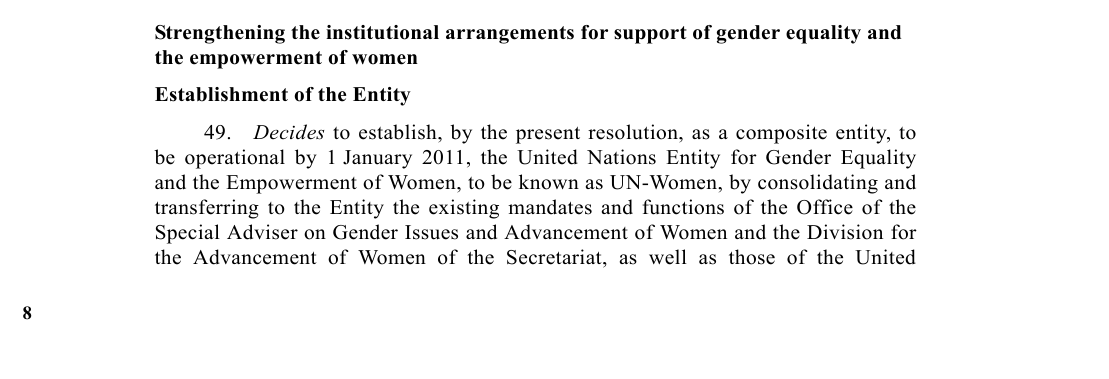
Our argument is that UN Women works. It has a founding resolution (General Assembly resolution 64/289, 2010), a board, a reporting line, and USD 594.4 million in contributions in 2024 by its own annual report. And the machinery around it works: women's share of UN professional posts rose from 39.7 per cent (A/59/299, 2004) to 50.4 per cent system-wide (A/80/260, 2025) once parity became a tracked, reported target. Aid to gender equality is measurable, about USD 71.8 billion a year, because an OECD marker exists to record it. Mandates, budgets and tracked targets produce results. UN Women is the proof.
For men and boys the UN system holds no equivalent at any level: no entity, no thematic special procedures mandate, no SDG indicator naming them as the disadvantaged group, no aid marker. Where anyone measures anyway: 493,456 of 727,043 suicide deaths worldwide are male (WHO Global Health Estimates, 2021); 81 per cent of homicide victims (UNODC, 2021); almost 93 per cent of prisoners (UNODC Prison Matters 2026); 94 per cent of children detained in justice, conflict and security settings are boys (A/74/136, paragraph 35).
Three questions, each answerable yes or no:
1. Does UN Women regard its own record as evidence that dedicated machinery produces measurable results?
2. Does UN Women hold, or know of, any mandate, programme or budget line anywhere in the UN system whose intended beneficiaries are men and boys for their own sake, rather than as partners in outcomes for women and girls? If yes, we will link to it prominently and say we were glad to find it.
3. If yes to 1 and no to 2: would UN Women oppose the creation of such machinery for men and boys, provided it takes nothing from women and girls?
We are writing to the Media Team as the address UN Women publishes for global enquiries. We publish replies in full, so this is, in the honest sense, a media enquiry.
We publish any reply in full and unedited. If we have not heard by 9 September 2026 we will simply record that we wrote on 19 August 2026.
With thanks,
Mikal Monslaup
UN for Men Too
unformentoo.org
Committee on the Rights of the Child Would the Committee name boys in the discrimination paragraph, as the Human Rights Committee already does? via ohchr.org · sent 19 August 2026
Dear members of the Secretariat,
I am writing from UN for Men Too, a campaign run by Manderådet in Denmark and MannsForum in Norway, not affiliated with the United Nations.
We counted the Committee's two general comments on the child justice system. General comment No. 10 (2007) and general comment No. 24 (2019) together run to 24,043 words. The word "girls" appears four times across them; the word "boys" appears in neither. On the UN's own figure (A/74/136, paragraph 35), boys are 94 per cent of children detained in the administration of justice, armed conflict and national security, which is the system both documents govern. Paragraph 40 of general comment No. 24 names girls, children discriminated against on the basis of sexual orientation or gender identity, and children with disabilities. Every one of those groups belongs there and we would not remove a word.
Three questions:
1. When the guidance on the child justice system is next revised, would the Committee consider naming boys in the discrimination paragraph, alongside the groups already named there?
2. We ask partly because another treaty body already writes that sentence. The Human Rights Committee's general comment No. 35 (2014), on liberty and security of person, lists who article 9 protects and begins: "girls and boys, soldiers, persons with disabilities, lesbian, gay, bisexual and transgender persons, aliens, refugees and asylum seekers, stateless persons, migrant workers, persons convicted of crime, and persons who have engaged in terrorist activity." The phrasing exists inside the system and was adopted a decade ago.
3. Is there a reason, which we may simply not know, why the child justice guidance takes a different approach from general comment No. 35 on this point? If there is a good one, we would publish it, because it answers a question we have been asking in public.
We publish any reply in full and unedited. If we have not heard by 9 September 2026 we will simply record the two dates.
With thanks,
Mikal Monslaup
UN for Men Too
unformentoo.org
OHCHR, special procedures Has a mandate for men and boys ever been proposed, and is the true mandate count 46 or 45? via ohchr.org · sent 19 August 2026
Dear colleagues,
I am writing from UN for Men Too, a campaign run by Manderådet in Denmark and MannsForum in Norway, not affiliated with the United Nations.
Two factual questions we could not answer from the public record, and an answer to either would be reported plainly whichever way it goes:
1. Has a thematic special procedures mandate concerning men and boys ever been formally proposed to the Human Rights Council? If it has, we would value the document symbol so we can read what happened to it. If it has not, that is equally useful to know. Proposed-and-rejected is a completely different story from never-proposed, and we will not guess which it is in public.
2. OHCHR's explainer states there are 46 thematic mandates as of November 2025. Extracting the thematic mandates listing on spinternet.ohchr.org on 19 August 2026 gives 45 titles. Which is right, and what are we missing? We currently publish both figures because we cannot reconcile them.
We publish any reply in full and unedited. If we have not heard by 9 September 2026 we will simply record that we wrote on 19 August 2026.
With thanks,
Mikal Monslaup
UN for Men Too
unformentoo.org
Norway, Barne- og familiedepartementet Status of NOU 2024:8's 35 measures, and does the government support a DAC marker for men and boys? via regjeringen.no · sent 19 August 2026
Til Barne- og familiedepartementet,
Jeg skriver fra UN for Men Too, en kampanje drevet av Manderådet i Danmark og MannsForum i Norge. Vi er ikke tilknyttet FN. Ingenting under foreslår å redusere noe tilbud til kvinner og jenter, og vi sier det på hver side vi publiserer.
Argumentet vårt er at maskineri virker, og at FNs egne tall viser det: kvinneandelen i FNs profesjonsstillinger gikk fra 39,7 prosent (A/59/299, 2004) til 50,4 prosent i hele systemet (A/80/260, 2025) etter at paritet ble et målt og rapportert mål. Bistand til likestilling kan tallfestes, omtrent 71,8 milliarder dollar i året, fordi en OECD-markør finnes som registrerer den. For menn og gutter finnes ikke noe tilsvarende på noe nivå: ingen enhet, ingen spesialprosedyre-mandat, ingen SDG-indikator, ingen bistandsmarkør. Der noen likevel måler: 493 456 av 727 043 selvmord globalt er menn (WHO, 2021); 94 prosent av barn i forvaring i rettsvesen, konflikt og sikkerhet er gutter (A/74/136, avsnitt 35).
Tre spørsmål:
1. Hvilke av de 35 tiltakene i NOU 2024:8 er gjennomført, hvilke er under arbeid, og hvilke er lagt bort? En statustabell publiseres i sin helhet.
2. Støtter regjeringen opprettelsen av en OECD DAC-markør for bistand rettet mot menn og gutter, ja eller nei? Markørprosessen er i bruk: ernæring, funksjonsnedsettelse og katastrofeforebygging bærer alle data fra 2018.
3. Ville regjeringen motsette seg at det opprettes maskineri i FN-systemet for menn og gutter, tilsvarende i art (ikke nødvendigvis i omfang) det som finnes for kvinner og jenter, forutsatt at det ikke tar noe fra kvinner og jenter, ja eller nei?
Vi publiserer ethvert svar i sin helhet. Har vi ikke hørt noe innen 9. september 2026, noterer vi bare at vi skrev 19. august 2026.
Med vennlig hilsen,
Mikal Monslaup
UN for Men Too
unformentoo.org
Denmark Does the government support the marker, and would it oppose UN machinery for men and boys? ministry contact route · sent 19 August 2026
Dear colleagues,
I write from UN for Men Too, a campaign run by Manderådet in Denmark and MannsForum in Norway, not affiliated with the United Nations. Nothing below proposes reducing any provision for women and girls, and we say so on every page we publish.
Our argument is that machinery works, on the UN's own numbers: women's share of UN professional posts rose from 39.7 per cent (A/59/299, 2004) to 50.4 per cent system-wide (A/80/260, 2025) once parity became a tracked target. Aid to gender equality is measurable, about USD 71.8 billion a year, because an OECD marker exists to record it. For men and boys no equivalent exists at any level: no entity, no mandate, no indicator, no marker. Where anyone measures anyway: 493,456 of 727,043 suicides worldwide are male (WHO, 2021); 94 per cent of children detained in justice, conflict and security settings are boys (A/74/136, paragraph 35).
Two questions, each answerable yes or no:
1. Does the Government support the creation of an OECD DAC policy marker for aid targeting men and boys? The marker process is in active use: nutrition, disability and disaster risk reduction all carry data from 2018.
2. Would the Government oppose the creation, within the UN system, of machinery for men and boys equivalent in kind (not necessarily in scale) to what exists for women and girls, provided it takes nothing from women and girls?
We publish any reply in full. If we have not heard by 9 September 2026 we will simply record that we wrote on 19 August 2026.
With thanks,
Mikal Monslaup
UN for Men Too
unformentoo.org
Two structural notes belong to the record. The Boltzmann Institute is the only recipient of the nine that publishes a plain email address, and it publishes it deliberately obfuscated against harvesting. UN Women's headquarters contact page publishes street addresses and telephone numbers and no email at all; its one global address, the Media Team's, sits behind a click-to-reveal on the media page. A letter whose replies are published in full is, in the honest sense of the word, a media enquiry, so that is the desk it went to.
What happens next, and what this is not
The follow-up article writes itself on 9 September, whichever way it goes.
Every reply is published in full and unedited before it is summarised anywhere. A reply that corrects this initiative gets the correction published prominently, in the corrections log that already lists 59 entries, many against our own interest. No reply becomes one sentence: we wrote on 19 August 2026 and had no reply by 9 September 2026. Nothing more. Busy institutions get a lot of mail, and silence is a date, not a verdict.
And to say plainly what this is not: it is not an attack, on UN Women least of all. Every letter cites UN Women as the proof that the model works, and every letter carries the sentence that nothing is asked for at the expense of women and girls. When this initiative reports on money or programmes in future, the narrative will stay what it is here: UN Women holds no mandate for men and boys, nobody does, and the findings that follow from that are findings about an empty chair, not about the people sitting in the other ones.
What would the machinery actually do? Count, review, report. Three dull verbs, and nothing about them is boring: they are the difference between a finding that becomes seventy rules and a finding that sits in a paragraph for seven years. The review half matters more in 2026 than it would have in 2004, for reasons that did not exist then.
Initiatives that reach the General Assembly today are reviewed for their impact on women and girls, through gender mainstreaming, and reviewed by nobody for their impact on men and boys. Machinery would mean every initiative is measured on outcomes for both sexes before adoption rather than defended after, and a design that cannot survive symmetric measurement gets improved quietly in committee instead of publicly years later. Quality assurance before adoption is cheaper than correction after it.
It is also the only calm answer to polarisation. An asymmetry nobody measures gets argued about in feeds, where it radicalises in both directions; an asymmetry somebody measures gets argued about in numbers both sides can check. And the stakes of the corpus itself have changed: everything the system publishes is now training data. A research record produced for twenty-two years by machinery that measures one sex's outcomes becomes the ground truth of every model trained on it, and at that point the gap stops being a filing error and starts being infrastructure.
And none of it waits for permission. The collecting continues here regardless: findings stamped and receipted, male outcomes mapped country by country across the UN's membership, the strange and the exemplary posted as they are found, the UN used as the comparison line in both directions, better and worse alike. It runs on this site's news page and on X at @Kairunen, and every claim of it carries its source the day it appears.
Last: the reason the letters could be written at this standard is that the campaign already runs the discipline it is asking the UN to adopt. Every figure carries its source, named in the register. Every correction is dated and published. Every claim that failed verification is published as failed. If machinery for men and boys is ever built, its first day of work looks like this site's ordinary Tuesday, and that is not an accident. It is the application form.
The working chain, receipted
The proof of success in the documents' own ink: UN Women established, the 2004 baseline, the 2025 milestone, the Bangkok Rules adopted. Each snippet is a quotation from the held original and opens full size; every full document is stored, hashed and linked from the register. Assembled by Mikal Monslaup and Claude, who share the credit for all of it.
Now that you have read: should machinery for men and boys exist inside the UN?
You have read what exists and what does not. One tap, counted publicly, for everyone.
Counted. The numbers update for everyone.
The button moves one number. A salted hash of your network limits repeats for an hour, nothing else is stored, and no answer is recorded against you.
The letters, one chain of machinery with a keeper at every step, and one question at the end of it that yes, no and silence all answer.
The count is done. Now it is on their desks.
There is a UN Women. There is no UN Men. This is the ask, and it takes one tap.
— voices so far · one tap, anonymous, no signup
Questions this article answers
Who did the campaign write to?
Nine recipients: the Ludwig Boltzmann Institute, the NGO Panel for the Global Study on Children Deprived of Liberty, the OECD Development Co-operation Directorate, the UN Statistics Division, UN Women, the Committee on the Rights of the Child, OHCHR's special procedures, and the governments of Norway and Denmark.
What was asked?
Closed questions built on a three-step chain: the recipient's own record shows machinery produces results; no equivalent machinery exists for men and boys; would the recipient oppose it being created, provided it takes nothing from women and girls. Plus recipient-specific factual questions, such as whether a DAC marker for men and boys has ever been proposed.
Is this an attack on UN Women?
No. Every letter cites UN Women as proof that the model works, and every letter states that nothing is asked for at the expense of women and girls. The campaign's finding is that UN Women holds no mandate for men and boys and neither does any other body. The empty chair is the finding.
When will the replies be published?
Each reply is published in full and unedited as it arrives. The reply-by date named in every letter is 9 September 2026. A recipient who has not replied by then is recorded in one sentence: we wrote on 19 August 2026 and had no reply by 9 September 2026.
What happens if a reply proves the campaign wrong?
The correction is published prominently in the site's corrections log, which already lists 59 dated entries, many made against the campaign's own interest. A reply that corrects us is the second-best outcome a letter can have.
What would machinery for men and boys actually do?
Count, review and report. Every initiative measured on outcomes for both sexes before adoption rather than defended after, sex-disaggregated data collected as a duty rather than a favour, and an annual report somebody is accountable for. The same functions the machinery for women and girls already performs, which is the proof they work.
Where this goes, and what would settle it
This one settles itself, on a date already named. Whatever arrives by 9 September 2026 is published in full, and whatever does not arrive becomes a dated sentence. Either way the follow-up article exists, and its shape is already known.
The letters themselves, with every figure and reference, are in a published record file, letter by letter, exactly as sent, so nobody has to trust this article's summary of what was asked.
If any recipient answers a question this site got wrong, the correction goes in the log with the date, prominently. That is not a risk of the method. It is the method.
The three documents this rests on
All three are public and are linked here directly rather than described. Read them yourself. That is the point of putting them at the top of their own section instead of at the bottom of a reference list.
A/RES/64/289 General Assembly resolution 64/289, establishing UN Women The founding resolution. Cited in the letters as step one of the working chain: a body exists because member states created one. 2 July 2010 Linked as the letters cite it Open it on documents.un.org → A/80/260 Composition of the Secretariat and system-wide personnel statistics The staffing report carrying women at 50.4 per cent of professional and higher posts system-wide, against 39.7 per cent in A/59/299 of 2004. The letters' evidence that tracked targets move. 25 July 2025 Read for the staffing article, 19 August 2026 Open it on documents.un.org → The letters and the send log The full text of all the letters, the addresses and routes used, the send dates and the reply-by date, in the published record file. Updated 19 August 2026 Open it on unformentoo.org →Source notes and accuracy flags
This section is part of the article, not an appendix to it. It records where each figure came from, what was checked, and every place where the honest version of a claim is weaker than the version that would have read better.
Source notes
- Every figure in the letters is in this site's register with its primary source: the 39.7 and 50.4 per cent staffing shares (A/59/299 and A/80/260), the 71.8 billion dollars a year of gender-marked aid (OECD DAC gender marker, 2023 to 2024 average), UN Women's 594.4 million dollars of 2024 contributions (its own annual report), and the four absence counts (UN system directory, OHCHR mandate listing, SDG indicator framework, DAC marker list).
- The OECD category list is transcribed in this site's research files as observed on 19 August 2026, with a dated screenshot held. Menus change; the list will be re-captured before any article rests on it alone.
- Eight letters went out on 19 August 2026. The ninth, to UN Women, followed on the resolved Media Team route, and the send log records each send with its date. This page is updated when the log is.
- The reply-by date, 9 September 2026, is three weeks from sending. It appears in every letter in the same words, so no recipient can be surprised by its use.
- The enactment's beats each carry their source on the figure itself: UNODC Prison Matters for the counts, A/RES/65/229 for the Bangkok Rules, A/74/136 paragraph 35 and the Global Study for the boys' track, the held GlobalGiving record for the fifty dollars. The women's track is machinery working as it should, and is presented as such.
- The poll uses the same worker and the same privacy model as the front page voice button: one number per answer, a salted network hash to limit repeats for an hour, nothing else stored. The counts are public through the same API the buttons use.
- The letters are reproduced verbatim, in the language each was sent in, which is why the Norwegian edition of this page carries them in English where English is what left the outbox.
- Threads are linked at thread level because they are the author's own posts; commenters are quoted on this site at community level and never named. The changemyview and geopolitics accounts are this site's own screenshots, already published with the first article's refused claims.
- The letters say campaign because that is the word that left the outbox on 19 August 2026. The site renamed itself an independent research initiative the same week, and sent text does not get edited retroactively, even for our own rebranding.
- The poll runs as two cohorts of the same question: one asked at the top of the page before the record, one at the foot after it. One vote per person, spent wherever the reader chooses, so the comparison is between people who answered on arrival and people who answered after reading, not the same people twice. Showing the counts before you vote can itself influence a vote, and this note is the disclosure of that.
Every figure in this article also appears in the register, with its exact value and primary source, and any correction to it will appear in the corrections log with the date it was made.
0 visits · 0 read to the end
This page keeps four anonymous totals: pages loaded, read to the end, a source or receipt opened, and the support panel opened. No identifier is stored, repeats are limited by a salted network hash that expires in an hour, Do Not Track switches it off entirely, and the totals are public through the same API that serves them.