UN for Men Too
the full argument →

Topics · 05 · Violence

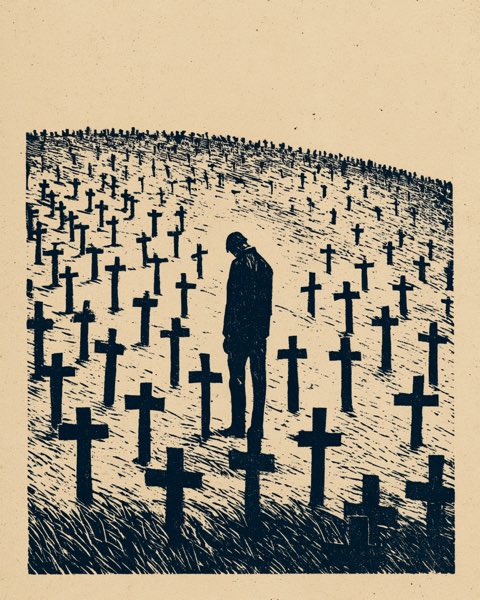
Eight in ten.

Every figure on this page comes from a United Nations document. The UN's own drugs and crime office counts eight in ten of the world's homicide victims as men and boys, and prints both columns of that finding in the same table. Nothing here disputes the other column, which is that women are the majority of those killed at home and by a partner, and this page states it in UNODC's own words. The question is narrower and harder: the system that collected the first number has built no instrument around it.

How to read this page: the sources are UNODC, WHO, UNICEF, OHCHR, the Security Council, a UN tribunal and the General Assembly's own rules. Where a figure needs its counterpart to be honest, the counterpart is in the same fact, not in a footnote. The last section is the one place where countries have gone further than the UN.

81%of the world's homicide victims are men and boys, UNODC 2021
94%of the world's prisoners are men, UNODC 2025
1 in 11boys worldwide subjected to sexual violence in childhood, UNICEF 2024
0UN rules, mandates or instruments built around any of it
§01

Who the UN counts among the dead

The United Nations already knows this. Every figure in this section is UNODC's own, from its own flagship study, and both columns are printed here exactly as UNODC prints them. The imbalance is not the finding. The finding is what follows from a number this large being collected for years and assigned to nobody.

§02

Who is targeted when it is organised

Conflict, where the UN does have mandates, monitors and annual reports. Male civilians are counted in them, and the instruments built around the counting name a different victim. The last node in this section is the one place the Security Council wrote male victims into the text.

§03

Who is in the cells

Ninety-four in every hundred prisoners on Earth are men. The UN has a dedicated set of rules for the other six, adopted by the General Assembly and named after the city where it was agreed, and no counterpart for the ninety-four.

§04

The boys

Where the UN's own agencies publish the numbers for children, boys appear in them, and the reporting frameworks around them do not. Girls face far higher rates of sexual violence and the instruments exist for that reason; this section is about what happens to the other column in the same tables.

§05

The one obligation still written by sex

Conscription is the only legal duty in the democratic world that a state may still impose on one sex alone. The UN's own treaty carves it out of the ban on forced labour without drawing a line between the sexes, and no UN treaty body has found the practice discriminatory. The countries at the end of this section did what the UN has not: they removed the line themselves.

§06

Checked, and we refuse to claim it

This is the topic where a careless sentence does the most damage, so the refuse list is longer than usual and the first entries are the ones that would have made this page louder. Violence against women is real, severe, and the reason the existing instruments exist. Nothing here disputes that, and any claim that needed it disputed was cut.

  • Men are the majority of victims of domestic, family or intimate partner homicide. Contradicted by the primary source. UNODC data for 2022 put women and girls at approximately 53 per cent of all victims killed by intimate partners or other family members and 66 per cent of victims of intimate partner killings across 78 countries; the 2021 study puts the intimate partner figure at 71 per cent across 75 countries. The male majority in homicide is a public-sphere pattern and reverses inside the home.
  • Because 81 per cent of homicide victims are men, violence against women is overstated. Rejected on both accuracy and framing. The two figures have different denominators and UNODC publishes them side by side in the same study; UNODC's own key message for 2021 is that women and girls are disproportionately affected by homicidal violence in the home. The campaign's position is additive, so no figure may be used to argue that another set of victims matters less.
  • UNODC reports that around 370,000 men were killed in 2021. Not a published UNODC figure. UNODC publishes an estimated total of about 458,000 homicide victims in 2021 and a male share of 81 per cent as separate statements, and does not print an absolute male victim count. The number is a multiplication of two published figures and must be labelled as derived, not quoted as UNODC's.
  • UN homicide statistics ignore or fail to count male victims. False as stated. The Global Study on Homicide 2023 carries a standalone key message headed on men being the most likely victims of homicide, publishes sex-disaggregated rates globally and for every region, and analyses age and sex profiles for the Americas and Europe. The narrower and defensible point, which UNODC states itself, is that data on intimate partner and family-related homicide are more available for female victims, so male trends in that specific category cannot be analysed in the same depth.
  • More women than men are murdered in Norway and other European countries, so Europe is uniquely dangerous for women. Misreads the source. UNODC lists Austria, Czechia, Iceland, Latvia, Norway, Slovenia and Switzerland as recording more female than male victims in 2021 and attributes it to their low overall homicide rates, where family and intimate partner homicide forms a larger share of a very small total. Europe had the lowest regional female homicide rate in 2021, at 1.2 per 100,000 female population.
  • Men are more likely than women to be physically injured by an abusive partner. ONS Partner abuse in detail, year ending March 2023, Table 9, does show 22.2% of male victims and 13.6% of female victims reporting any physical injury, which is why the claim circulates. It fails on inspection. The unweighted bases are only 146 men and 347 women, the most severe category (internal injuries or broken bones or teeth) is suppressed for both sexes as too small to publish, and the measure is share of victims rather than population rate. It also runs against the homicide and repeat victimisation evidence from the same publisher. Publishing it would stake the most dangerous topic on the site on a base of 146 respondents, and it would read as minimising violence against women.
  • Domestic abuse is roughly symmetrical between the sexes, so services should be too. The prevalence numbers are closer than most people assume, but ONS gives 9.1% for women against 6.5% for men in the year to March 2025, and every severity indicator from the same source is asymmetric: 72.1% of police recorded domestic abuse crimes and 69.6% of domestic homicides have female victims. ONS also states its questions cannot produce a coercive control estimate, and the research consistently finds women bear more of the repeated and controlling abuse, so the survey gap understates rather than overstates the asymmetry. A symmetry claim is false, and on this topic it would be read as denial.
  • There are no refuge places for men in England, and London has none at all. Contradicted by the sources. Women's Aid's Routes to Support recorded 66 refuges in England with a bedspace for men on 1 May 2025 and 439 bedspaces available to women or men, and MHCLG recorded 610 male adults supported in safe accommodation in London in 2024 to 2025. The London claim traces to an undated advocacy briefing rather than a census. The accurate figure is narrower and stronger anyway: 39 bedspaces in England dedicated to men.
  • Denmark had no crisis centre provision for men before the 2024 law. Mandecentret ran accommodation for men under section 110 of the Social Services Act from 2015. What LOV nr 329 af 09/04/2024 changed, with effect from 1 July 2024, was the statutory right under section 109 and the entitlements attached to it, including bringing accompanying children, municipal counselling and psychological support. Stating that nothing existed before would be easy to disprove and would discredit the accurate and more interesting point, which is that a country rewrote one word of statute and produced a counted population within six months.
  • Male victims have few refuge places because funding was diverted from men to women. No source supports a transfer of funding, and the claim asserts motive rather than reporting an action, which the project's rules forbid. It is also contradicted by the provision data: on 1 May 2025 England's refuge provision for women was itself 1,150 bedspaces short of the Council of Europe minimum, a 19.9% shortfall, and MHCLG recorded 28,190 households that could not be supported. Both columns are under provided. The defensible statement is about what is counted and provided, not about who took what from whom.
  • A global count such as "only 12 countries conscript women" or "X countries conscript men only". No usable current inventory exists. The standard reference, the CIA World Factbook field "Military service age and obligation", was sunset by CIA on 4 February 2026 and its country pages now redirect. Its final entries carried dates from 2023 to 2025 and were already stale: the Denmark entry still recorded conscription as men-only with women eligible only to volunteer, which the July 2025 law reversed. I retrieved the archived final field data (178 entries) and found that any count depends entirely on unstated coding rules, since roughly a dozen entries describe conscription that is authorised but never implemented, suspended, or reportedly not enforced (Belize, Indonesia, Netherlands, Slovakia, Somalia, Uruguay, Cote d'Ivoire and others), and some countries appear in one bucket or another purely on wording. War Resisters' International and the European Bureau for Conscientious Objection publish country-by-country reports with no aggregate. A number produced by my own coding would be my analysis presented as a source figure, which fails the standard. Use the Brun keyfact instead: it is a court's own comparative finding, time-scoped and quotable.
  • The UN, or a UN human rights treaty body, has found men-only conscription to be discrimination. No such finding was located. The ICCPR's Article 8 § 3 (c) (ii) carve-out for military service contains no sex qualification in either direction, and searching Human Rights Committee jurisprudence and concluding observations surfaced only conscientious objection issues, principally the punitive length of alternative civilian service, not sex-based liability. The absence of a located finding is not proof that none exists, so the claim should be stated as what the treaty text says and what courts have decided, never as a UN ruling.
  • Karlheinz Schmidt v. Germany establishes that requiring only men to serve breaches the European Convention. The judgment does not say that. At § 28 the Court held that what was "finally decisive" was that no man in that municipality was in practice ever obliged to serve, so the levy had stopped being compensatory and had become a pure tax on men. The Court expressly left open whether men and women may be treated differently as regards compulsory fire service itself, and the decision was six votes to three. In Brun v. Switzerland (2026) the Court distinguished Schmidt precisely because Swiss military service is actually performed. Citing Schmidt as a general rule would be a serious overclaim and would be corrected by any lawyer reading the page.
  • Denmark started conscripting women on 1 July 2025. Imprecise and easy to falsify. From 1 July 2025 women turning 18 become liable and are summoned to Forsvarets Dag, which is held during 2026, where they draw a lottery number. The first cohorts actually conscripted on equal terms begin in 2026, with some groups from February 2026 and the 11-month service from August 2026 (Forsvarsministeriet, 25 March 2025; EBCO Annual Report 2025). State the liability date and the service date separately.
  • Conscription is forced labour, so men-only conscription is a form of forced labour imposed by sex. Both governing instruments expressly exclude it. ICCPR Article 8 § 3 (c) (ii) excludes "any service of a military character" from forced or compulsory labour, and ECHR Article 4 § 3 (b) uses the same phrase. In Brun the Court confirmed Article 4 was applicable only as the anchor for an Article 14 discrimination claim, not because conscription is forced labour. The defensible framing is about who the state compels and on what ground, not about forced labour.
  • Men are around 90 per cent of the people killed in war worldwide. No source supports a global sex breakdown of conflict deaths. PRIO's 2009 review for the Norwegian Ministry of Foreign Affairs found practically no global data allowing this, and the UCDP Georeferenced Event Dataset codebook version 23.1 still contains no sex or gender variable. Country-level figures vary enormously, from 62 per cent male among sex-known verified civilian deaths in Ukraine to 87 per cent male among the missing in Bosnia, so a single global percentage cannot be defended. Any such number circulating online is an extrapolation, not a measurement.
  • Srebrenica proves that men are the primary targets of genocide. Overstates what the ICTY actually held. The Appeals Chamber in Krstic (IT-98-33-A, paragraphs 22 to 27) records that the Trial Chamber did not treat the men of military age as a separate protected group; it treated their killing as evidence from which to infer intent to destroy the entire Bosnian Muslim community of Srebrenica. The forcible transfer of about 25,000 women, children and elderly was part of the same criminal conduct and was convicted as a crime against humanity. The defensible claim is narrower and stronger: the selection was made by sex, and the tribunal said so.
  • Most victims of conflict-related sexual violence are men. False on every UN figure available. The UN Office of the SRSG on Sexual Violence in Conflict put women at 92 per cent of victims in the 2024 verified caseload, and every annual Secretary-General report, including S/2026/321 covering 2025, states that women and girls continue to constitute the vast majority of victims. Publishing this claim would be both wrong and fatal to the campaign's credibility.
  • The UN does not recognise male victims of conflict-related sexual violence. False as a matter of record. Security Council resolution 2467 (2019) paragraph 32 expressly recognises men and boys as targets and urges member states to protect them, resolution 2106 (2013) noted it preambularly, and the Secretary-General's annual reports carry a standing passage on male victims and detention. The accurate and verifiable point is about the scale of the provision, not its existence: the UN publishes a percentage share for women victims and no corresponding count for men and boys.
  • In Ukraine, most victims of conflict-related sexual violence are men. True only of the documented caseload as a whole and misleading without its scope. OHCHR's own breakdown shows the male majority comes from prisoners of war and civilian detainees, while among the 96 civilians attacked in residential areas the mission recorded 70 women and 14 girls against 11 men and 1 boy. Stated unqualified it would invert the picture for civilians outside captivity, so the detention scope must travel with the figure or the claim must not be used.
  • Male prisoners are more likely to die by suicide than female prisoners. The best-documented data contradict it. MoJ table 1.1 for England and Wales gives 1.04 self-inflicted deaths per 1,000 male prisoners against 1.15 per 1,000 female prisoners over 2016 to 2025, with the female rate higher in five of those ten years. Men are 95 per cent of these deaths only because they are 96 per cent of prisoners. Stating it as a higher male risk would be factually wrong and would invite exactly the rebuttal the campaign cannot afford.
  • Prison is more violent for men than for women. Not supported on rate. MoJ Safety in Custody for the 12 months to March 2026 records the assault rate as nearly twice as high in female establishments as in male establishments, with the serious assault rate also higher in the female estate, and the self-harm rate in the female estate at 5,643 incidents per 1,000 prisoners against 610 in the male estate, over nine times higher. Only absolute counts favour the claim, and absolute counts follow population size.
  • Courts sentence men more harshly because of bias against men. This is a motive claim and the source explicitly refuses it. Starr writes that despite the rich set of covariates she cannot definitively answer the causal question because unobservable gender differences remain possible. What is measurable is the size of the unexplained gap after named controls, which is what the keyfact reports.
  • The UN ignores male prisoners. False. The Nelson Mandela Rules (GA resolution 70/175) apply to all prisoners without discrimination and therefore cover the 94 per cent of prisoners who are men. The accurate and defensible claim is narrower: no UN instrument addresses male prisoners as a group, while a 70-rule instrument exists for women.
  • Prison suicide rates show male prisoners are three times more at risk than men in the community. The arithmetic is not sex-specific. UNODC's 2025 report gives 32.9 suicides per 100,000 prisoners across 84 countries against a global crude rate of 9.1 per 100,000, but its own footnote states the comparison does not take into account the demographic structure of prisoners, which are in large majority male. The comparison is neither sex-standardised nor age-standardised and cannot carry a male-specific risk ratio.
  • 1 in 6 men were sexually abused as boys. The 16% figure comes from Dube et al 2005 in the American Journal of Preventive Medicine, based on adult members of a Kaiser Permanente health plan in San Diego County who completed a routine health appraisal. It is a single clinical membership sample, not nationally or globally representative, and it uses a broad contact abuse definition. It is routinely recirculated as if it were a world figure. UNICEF's 2024 global estimate for rape or sexual assault in childhood among boys and men is about 1 in 11, and the ONS Crime Survey puts contact sexual abuse before 18 at 2.9% of men in England and Wales. Using 1 in 6 as a global or national number overstates the evidence and would be the easiest single claim on the page to discredit.
  • More than half the world's countries have no law against the rape of boys. This traces to the Economist Intelligence Unit Out of the Shadows Index, and that report states the number in two opposite directions. Its executive summary says just over half, 33 of the 60 indexed countries, have legal protections for boys within their child rape laws. Its Box 1 says child rape laws in just over half, 33 of the 60, lack such protections. WHO's Global Status Report on Preventing Violence Against Children 2020 repeated the second reading. A self contradictory source cannot support a number, and the index covers 60 countries, not the world. The verifiable line from the same report is narrower: only 19 of the 60 indexed countries collected prevalence data on sexual abuse of boys, and just six did so for child sexual exploitation.
  • Boys and girls are sexually abused at similar rates. Every dataset checked contradicts this. UNICEF 2024 gives 1 in 8 girls and women against 1 in 11 boys and men for rape or sexual assault in childhood, and the female estimate rests on far better data. Moody et al 2018 found girls higher in all three well studied continents. ONS 2024 found 13.9% of women against 4.1% of men. UN verified conflict data for 2025 recorded 1,745 girls among 1,771 child victims of sexual violence. The campaign's defensible claim is that boys are undercounted and underserved, not that the two columns are equal, and asserting equality would misrepresent the sources it relies on everywhere else.
  • UN child protection instruments name girls but not boys. For children the core instruments are sex neutral in their text. The Convention on the Rights of the Child and its Optional Protocols apply to every child, SDG target 16.2 covers all children, and SDG indicator 16.2.3 explicitly measures young women and men. Security Council resolution 2106 (2013) expressly recognised that conflict related sexual violence affects men and boys, and resolution 2467 (2019) covers all victims and survivors including men and boys. A narrower version does survive and should be used instead if the point is needed: SDG target 5.2 is written as violence against all women and girls, and its indicators 5.2.1 and 5.2.2 count only female victims aged 15 and over, with no equivalent SDG target or indicator for males. The demonstrable child level gap is in measurement and services, not in treaty language.
  • Boys are the majority of child homicide victims at every age. UNODC's Global Study on Homicide 2019 reports near parity below age 10, with global homicide rates of 0.80 per 100,000 for boys and 0.76 for girls aged 0 to 9 in 2016. The male majority comes overwhelmingly from older children, reaching 9.28 against 1.78 per 100,000 for ages 15 to 17. UNODC also notes that girls make up a larger share of child homicide victims than of adult homicide victims, and that killings of the youngest children are mainly perpetrated within the family. The accurate claim is that the sex gap in child homicide opens after age 9 and is widest in adolescence, which is a stronger and more specific point than the overstated version.

The United Nations counted every one of them. Then it assigned the file to nobody.

A campaign by Manderådet and MannsForum · unformentoo.org