 UN for Men Too
Menu
Read
- Is there a UN for men? The short answers
- Gendered and raced at once
- Is it true?
- What countries have done
- The objections, answered
- UN Women and UN Men compared
- News, everything published here
- UN Women wrote that men die younger. Then handed them a reading list about someone else.
- UN for Men? They wrote it down in 2004.
- One life, in the numbers that exist
The evidence
- The Archive: men's statistics, every cell sourced
- The register: every claim and its source
- The gap, in one picture
- The machinery: markers, outcomes and parity, live
- Why fathers matter
- Male suicide
- Family law and Article 8
- Boys and education
- Violence against men and boys
- The pushback, documented
- The research agenda
The ask
Language
UN for Men Too · article
Then it handed them a reading list
UN Women wrote that men die younger. Then handed them a reading list about someone else.
In September 2024 UN Women published an explainer stating, in the organisation’s own words, that pressures on men “even reduce men’s life expectancies” and that men are “significantly more likely to die by suicide than women”. Four sentences later it sets out what they can do about it. There are five items, and every one of them is a change men are asked to make about themselves. Not one is a thing that would be there for them. This is not a complaint about UN Women. It is what happens when the body that writes the sentence down is not the body that could act on it.
Four sentences
What the page says about men, in its own words, before it says anything else.
I went looking for this. Two days into reading everything the United Nations has published about men and boys, I wanted to be able to say what it actually says rather than what people assume it says, so I searched for it. What I expected was the usual: men as a problem to be managed, or men as an audience to be recruited. Both are there. So is something I have not seen a UN entity write this plainly.
Before any of that, the plain test. I typed the question into Google the way anyone would: is there un for men? This is the closest thing I can find to an answer, and it is a machine summarising the United Nations to me.
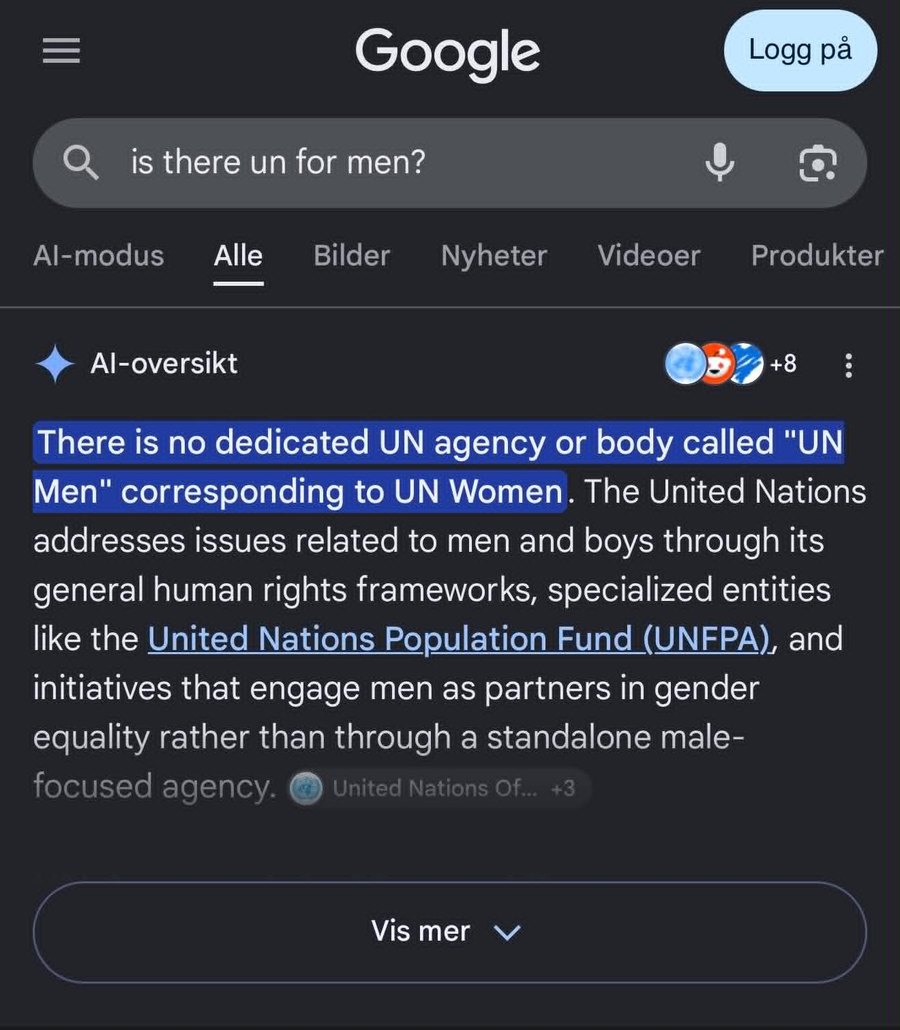 See the capture
Patriarchal social norms harm men’s physical and emotional wellbeing.
These pressures even reduce men’s life expectancies.
Men are also significantly more likely to die by suicide than women.
Read those again and notice what they are. Not a men's organisation's claim. Not a campaign's framing. The organisation the United Nations created for gender equality, stating on its own website that men die earlier and kill themselves more often. Everything this campaign has been accused of inventing is on unwomen.org, in the present tense.
It gives no figure for either. That matters and I am not going to blur it: the page states the direction and stops. The 5.2 year gap this site publishes comes from Eurostat, not from here, and the two should not be welded into one sentence.
Then the list
Having told him that the pressure on men shortens their lives, the page turns to what he should do about it. Five things. Read what they are.
So it knows. That is the part worth sitting with before the rest of this. Somebody at UN Women wrote those four sentences, somebody edited them, somebody approved them, and they went up on the organisation's own site in September 2024. The shorter life is not news to them. Neither is the suicide. Then comes the remedy, and I did not trust my own ear for the tone, so I pulled every sentence in the body that prescribes an action to men. There are five. Here they are in order.
What the page asks of him, and what it offers him
Asked of him
- 01Embrace vulnerability “in their emotional lives”, and take “active roles in domestic labour and caregiving”.
- 02Question his power, and “challenge harmful narratives that promote dominance and control over women”.
- 03“Challenge sexist and misogynistic behaviours anywhere they encounter them.”
- 04Understand that doing so will “not only reduce negative actions against women, but also advance the cause of gender equality”.
- 05Use “their existing privilege in society to disrupt the social structures that give them such privilege in the first place”.
Offered to him
- A service
- A programme
- A helpline
- A screening pathway
- A budget line
- An indicator
5things he is asked to change about himself
0things that would be there for him
UN Women, “How men and boys can push for gender equality”, 23 September 2024unformentoo.org
Read the list again and look for the man in it. Every item is something he must change about himself. Not one is a thing that would be there for him. Two paragraphs earlier the page said he dies earlier and kills himself more often. Five instructions later, it has not offered him a single service, programme, helpline, screening pathway, budget line or indicator. The one resource it names is a toolkit for being a better colleague to women at work. He was told his life is shorter, and handed a reading list about someone else.
The only resource the page points to is the HeForShe Male Allyship Toolkit, described there as “a comprehensive guide designed to support men in the workplace to be allies in the pursuit of gender equality”. It was launched in 2024 by the HeForShe Alliance, and its own announcement says what it is for without any help from me.
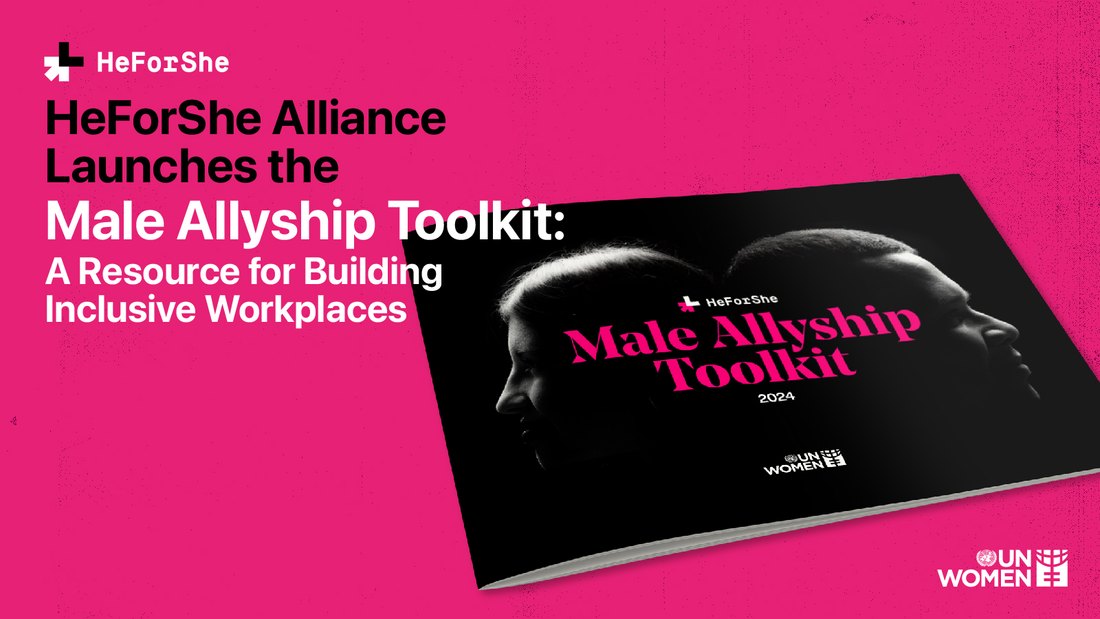 See the announcement
I want to be careful here, because there is an easy version of this paragraph and it is the wrong one. Allyship work is not silly. Men taking on caregiving is good for men. Challenging misogyny is worth doing on its own terms and I am not going to pretend otherwise to score a point.
feminist movements ensure that TPM efforts also align with broader gender equality objectives and remain accountable to feminist principles
That sentence is an organisation saying plainly whose objectives its men-and-boys work answers to. It answers to gender equality objectives for women and girls, which is what UN Women exists for.
The same year, twenty years apart
The sentence UN Women published in 2024 had already been adopted, almost word for word, in 2004. Except in twenty years nothing was ever attached to it.
Here is where I lose the readers who wanted a villain. I cannot hand you one. What is there instead is worse, because you cannot sack it.
In March 2004 the Commission on the Status of Women adopted agreed conclusions at its forty-eighth session stating that men and boys sometimes face discriminatory barriers and practices. The Economic and Social Council endorsed them. Twenty-eight words, in a negotiated text, carried by the body the United Nations has for this. Assigned to nobody.
In September 2024 UN Women wrote that the pressures on men reduce their life expectancy and that men die by suicide significantly more often than women. Four sentences. Published on its own website. Assigned to nobody.
Two decades apart, the same institution wrote down that something is wrong with how men are living and dying, and both times the sentence had nowhere to go.
UN Women's mandate is women and girls. It says so, it was created to do that, and it does it. If it opened a suicide prevention programme for middle-aged men tomorrow, the first and correct objection would be that this is not what it is for and not what its donors funded. Asking UN Women to carry men's outcomes is asking the wrong body, and I am not asking it.
But look at what that leaves. The only entity in the system that has written these sentences down is the one whose job is something else. So the sentences get written, and then the only available response is the one you can give to a person rather than to a system: here is what you could do differently.
That is why the list reads the way it does. It is what remedy looks like when there is no department to send the problem to. You get advice, because advice is free and does not require a mandate. A man told he will die five years early, and handed a list of things to work on about himself, has not been failed by the person who wrote the list. He has been failed by the fact that the list was the only thing anyone was in a position to write.
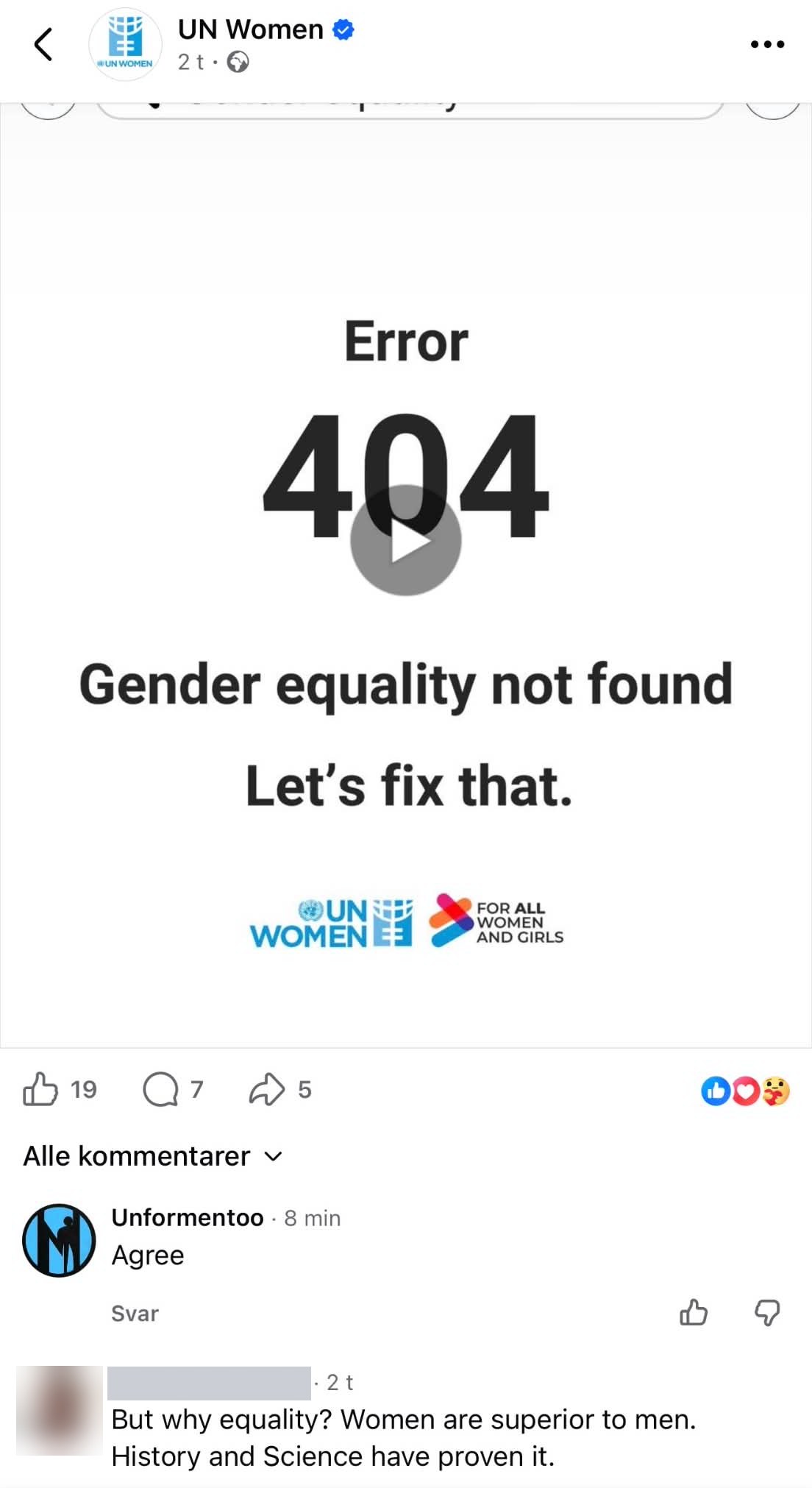 See the post
What would have to exist for those sentences to go anywhere
- A body with men and boys in its mandate, so a statement about male life expectancy has an owner.
- A focal point, so a member state asking who handles this is told a name instead of a shrug.
- An indicator, so the direction can be reported every year rather than mentioned once every twenty.
None of these takes anything from women or girls. The ask is additive and says so verbatim: it does not propose reducing UN Women's budget. That line appears three times on the homepage because it is the thing most often assumed and least often read.
So what do I want from that page? Not a retraction. Not an apology. Those four sentences are the best thing on it and I would like them quoted more, not less.
I want the next person who writes them to have somewhere to send them.
One more thing, and it is the part I understand least. Almost nobody argues with this. The replies I get, in rooms built to disagree with me, are mostly some version of yes, obviously. And yet I cannot find anyone writing it down. Thousands read the register and the thread; almost none of them says anything in public.
A subject can be agreed with and still be uncomfortable to be seen agreeing with, and that is a different problem from being wrong. I do not have a finding on it yet, so I am not going to dress a hunch as one. It is what I am digging into next, and whatever turns up gets published here whether or not it helps.
What I can say is the shape. We tell men to speak. We have built campaigns and helplines and advertising on the instruction that men should say what is wrong. And the thing most likely to be wrong is the one subject that goes quiet the moment it is raised. Asking men to talk and flinching at the subject cannot both be the plan.
These pressures even reduce men’s life expectancies.
There is a UN Women. There is no UN Men. This is the ask, and it takes one tap.
— voices so far · one tap, anonymous, no signup
Questions this article answers
Does UN Women work on men and boys?
It publishes on men and boys as partners in gender equality. Its explainer of 23 September 2024 says patriarchal norms \u201charm men's physical and emotional wellbeing\u201d and that these pressures \u201ceven reduce men's life expectancies\u201d. What it then asks of men is behaviour: embrace vulnerability, take on caregiving, question their power. The only resource it names is a workplace allyship toolkit.
Has the UN said that men die younger?
UN Women has, in its own words, writing that pressures on men \u201ceven reduce men's life expectancies\u201d. It states the harm and then offers no service, programme or referral addressed to it.
Is UN Women responsible for men's issues?
No, and this site does not argue it should be. Its mandate is women and girls and it says so. An entity mandated for women cannot be blamed for not being an entity for men. The point is that no other entity is.
What does UN Women ask men to do?
Five things, all of them changes to the reader's own conduct: embrace vulnerability, take on caregiving, question their power, challenge misogyny, and speak up. Nothing in the piece is offered to him.
Where this goes next, and where it gets written down
There is no organisation paying me for this and nothing here to donate to. One person, no budget, a laptop and a lot of PDFs. I am not going to pretend that is a virtue. It is just the situation.
The work continues either way, and all of it lands in one place. Every new figure goes into the register with its exact value, its scope and a link to the primary document, so you can check it without taking my word for anything. Every time I get something wrong it goes into the corrections log with the date and what changed, including the ones that were embarrassing. Every question I find that nobody can answer yet goes onto the research agenda with the prior work and what its own authors say it could not do.
That is the whole method. Find a document, read the document, publish what survives, publish what did not, and say so when I have to take something back. This article is one entry in that. There will be more, because I keep finding things, and 2004 and 2007 are unlikely to be the end of it.
If you want to help, follow it. That is not a euphemism and there is no later step where I ask you for money. A case with receipts and people watching is harder to file in a drawer than one man with a spreadsheet, and I would rather have the witnesses than the funding.
The three documents this rests on
All three are public and are linked here directly rather than described. Read them yourself. That is the point of putting them at the top of their own section instead of at the bottom of a reference list.
UN Women explainer How men and boys can push for gender equality 23 September 2024 Open it on unwomen.org → Google AI overview for “is there un for men?” 17 August 2026 Open it on google.com → E/2004/27 Agreed conclusions 2004/11, the role of men and boys in achieving gender equality 12 March 2004 Open it on un.org →Source notes and accuracy flags
This section is part of the article, not an appendix to it. It records where each figure came from, what was checked, and every place where the honest version of a claim is weaker than the version that would have read better.
Source notes
- Both UN documents were downloaded and read in full on 16 August 2026 before a word was written about them: the 2004 agreed conclusions and the 2007 moderator’s summary. Both URLs contain encoded spaces and break if a copy-paste step decodes them.
- Two texts of paragraph 2 exist. The advance unedited version on un.org, headed 12 March 2004 as adopted, reads "men and boys, while some themselves face discriminatory barriers and practices". The text ECOSOC endorsed and published reads "while men and boys sometimes face discriminatory barriers and practices". Most differences between the two documents are house style. This one moves the meaning. The endorsed version is quoted here, and it is the weaker of the two for this argument. This site published the other wording for a day and corrected it.
- The Bufdir guideline counts come from extracting the full PDF and searching it. A careless case-insensitive search for "emk" returns seven hits, all of them inside fremkomme and fremkommer. Searched as a word it returns zero. The document does cite Grunnloven section 104 and article 12 of the Convention on the Rights of the Child, on the child’s right to be heard.
- Homicide figures: UNODC Global Study on Homicide 2023, page 56, for 2021, with the relationship breakdown from the executive summary.
- Suicide figures: WHO Global Health Estimates for 2021, 493,456 male deaths of 727,043. The hourly rate is that figure spread across the year, set against UNODC’s own published 52 homicides an hour.
- The separated-men odds ratio is Wilson et al. 2025, 75 studies across 30 countries. It is an association, not a demonstrated cause.
- Coverage on indicator 16.2.3 applies to low- and middle-income countries; high-income countries are outside the comparable count for both sexes.
- UN Women contributions are the 2024 figure from its own annual report. Contributions received, not a budget.
- The count of UN observance days for women and girls is mine, from the UN list of international days. The UN does not publish that total.
- Threads are linked at subreddit level rather than by permalink, and the commenters in them are not named.
- The account of Arendalsuka, the theft and the police response is my own. I have not published the tracker location or any address.
Every figure in this article also appears in the register, with its exact value and primary source, and any correction to it will appear in the corrections log with the date it was made.
0 visits · 0 read to the end
This page keeps four anonymous totals: pages loaded, read to the end, a source or receipt opened, and the support panel opened. No identifier is stored, repeats are limited by a salted network hash that expires in an hour, Do Not Track switches it off entirely, and the totals are public through the same API that serves them.