 UN for Men Too
Menu
Read
- Is there a UN for men? The short answers
- Gendered and raced at once
- Is it true?
- What countries have done
- The objections, answered
- UN Women and UN Men compared
- News, everything published here
- UN Women wrote that men die younger. Then handed them a reading list about someone else.
- UN for Men? They wrote it down in 2004.
- One life, in the numbers that exist
The evidence
- The Archive: men's statistics, every cell sourced
- The register: every claim and its source
- The gap, in one picture
- The machinery: markers, outcomes and parity, live
- Why fathers matter
- Male suicide
- Family law and Article 8
- Boys and education
- Violence against men and boys
- The pushback, documented
- The research agenda
The ask
Language
UN for Men Too · article
Three fathers, and 114 mothers
More than 99.9 per cent of parents who keep a child with them in prison are mothers. The UN called that a gender stereotype, then wrote the remedy for caregivers in general.
Chapter 8 of the UN Global Study on Children Deprived of Liberty carries a section headed Gender Stereotyping: The Lack of ‘Father-Child Units’ in Most Countries. Of the 92 states that answered its questionnaire, eight allow a child to live with an imprisoned father. Denmark is one of them. Norway is not. In Finland, across five years, three imprisoned fathers kept their children with them, against 114 imprisoned mothers. The study gives four honest reasons for that gap before saying it also reflects a stereotype. Unlike the finding about boys, this one reached the General Assembly intact. What changed was the word used to fix it.
Eight countries out of ninety-two
Ninety-two states answered the UN's questionnaire about children living with a parent in prison. Eight of the answers were yes.
The Global Study on Children Deprived of Liberty sent a questionnaire to states and received 92 replies. One of the things it asked about was whether a young child may live with a parent who is in prison. Almost everywhere, the answer is that a child may live with an imprisoned mother.
The study puts the other half of the answer in one sentence, on page 270.
Only eight, mostly European States (Belgium, Bolivia, Denmark, Finland, Germany, Italy, Spain and Sweden), allow children to co-reside with their fathers in prison. Since appropriate ‘Father-Child Units’ are missing in most countries, only Finland provided information that between 2012 and 2017, three imprisoned fathers (as compared to 114 imprisoned mothers) co-resided with their children (73 girls and 54 boys) in Finnish prisons.
Three fathers. One hundred and fourteen mothers. Finland is the only country that supplied the figure, and Finland is one of the eight that permit it at all. It is, in other words, the good case.
The eight are Belgium, Bolivia, Denmark, Finland, Germany, Italy, Spain and Sweden. The study draws them as a chart on page 421. Denmark is on that list. Norway is not. Neither is any of the other eighty-four states that answered.
From those replies the study calculates a figure it states plainly, and it is the number this article is about.
more than 99,9% of primary caregivers who are allowed to co-reside with their dependent children in prison are mothers
The four reasons the study gives first
There is an obvious objection to all of this, and the study makes it before anybody else can. It is a good objection. Printed here in full, because leaving it out would be the same trick this site exists to document.
There is an obvious objection to everything above, and the study makes it before anyone else can. It is a good objection and it is right. Here it is complete, in the study's own words, immediately after the 99.9 per cent figure.
The fact that more than 99,9% of primary caregivers who are allowed to co-reside with their dependent children in prison are mothers can be explained, at least to a certain extent, by the breastfeeding needs of mothers and the stronger bond that may exist between infants and mothers. In addition, many children who live with their mothers in prison, were born while their mothers were already detained. Research also reveals that among sentenced prisoners, mothers are much more frequently the primary caregivers for their children.
Four reasons: breastfeeding, the bond between infants and mothers, children born while the mother was already inside, and the fact that among sentenced prisoners mothers are far more often the primary caregiver. None of those is a stereotype. All of them are real, and together they explain a great deal of a very large gap.
This site's position is that they explain a great deal and not all of it, and that position is not ours. It is the study's, in the next two sentences.
Nevertheless, the high rate of mothers among primary caregivers in prison also reflects a certain gender stereotype. Even States, which allow co-residing of children with their fathers, seem to find it not necessary or desirable to provide for proper ‘Father-Child units’ in male prisons.
Not necessary or desirable. That is the study describing states that have already decided in principle that a child may live with their father, and then not built the room.
The section this comes from is not an aside buried in a chapter about something else. It has a number and a title in the study's own contents, on page 256: 4. Gender Stereotyping: The Lack of ‘Father-Child Units’ in Most Countries. The study named it, and named it as stereotyping, before we did.
A word that cannot build a room
The last article followed a finding that never reached member states. This one did reach them, intact. Except what came back was a remedy addressed to somebody who does not exist.
The previous article on this site followed a finding about boys that did not survive the journey from the 804-page study to the 23-page note sent to the General Assembly. This one is not that story. This finding survived. It is paragraph 37 of A/74/136, and it is more specific there than in the study.
Although most States allow convicted mothers to co-reside with their young children in prison, only eight States explicitly permit fathers to do so. Even in places where fathers as primary caregivers are allowed to co-reside with their children, there are (almost) no appropriate “father and child units” in the prisons, which means that there are practically no children co-residing in prison with their fathers.
So every member state was told. The count of eight, the absence of the units, and the consequence: practically no children in the world live in prison with their fathers. That is in the operative document, in plain language, with a number attached.
Then come the recommendations, and the language changes. In the recommendations chapter of that note the phrase primary caregiver appears ten times. The word father appears none. Here is the one that sets the frame.
In all matters related to criminal proceedings involving primary caregivers of young children, usually mothers, it is essential to ensure recognition of the affected children as rights holders.
Read as a sentence it is unimpeachable, and the parenthesis is honest: usually mothers. Read as a remedy for the thing recorded eighty paragraphs earlier, it does nothing at all, because the finding was never that fathers are being refused permission. In eight countries they already have permission. The finding was that there is nowhere to put them.
A recommendation addressed to primary caregivers in general reaches a father the moment a father-child unit exists, and not one moment before. Neutral words are the right words for a neutral problem. This one has a wing of a building missing from one side of it.
What the note told member states, and what it went on to ask for
Told, in the findings
- 01Only eight states explicitly permit fathers to co-reside with their children.
- 02There are almost no appropriate father and child units anywhere.
- 03Practically no children co-reside in prison with their fathers.
- 04More than 99.9 per cent of co-residing primary caregivers are mothers.
Asked for, in the recommendations
- A father and child unit
- A count of states without one
- A duty to report the number
- An owner for the finding
10times the recommendations say primary caregiver
0times they say father
A/74/136, findings at paragraph 37 and the recommendations chapterunformentoo.org
There is one place in the world where this question has been answered in law, and it is not Europe. The study finds exactly one treaty provision anywhere that addresses it.
The only provision in international and regional human rights treaty law, which explicitly addresses this question (namely Article 30 of the African Charter on the Rights and Welfare of the Child of 1990), exclusively speaks of ‘Children of Imprisoned Mothers’. However, the African Committee on the Rights and Welfare of the Child has interpreted the word ‘mother’ in this provision as to also include fathers and other primary caretakers.
The only instrument on earth that speaks to this says mothers, and the body that administers it decided that mothers includes fathers. A committee read a sex-specific word and gave it to the children on the other side of it. No new treaty, no new fund, no new agency. A reading.
That is worth sitting with, because it is the answer to the objection that this is difficult. Somewhere it was done, by the poorest continent's human rights body, at the cost of an interpretation.
The receipts
The passage this article rests on, cut out of the page it is printed on.
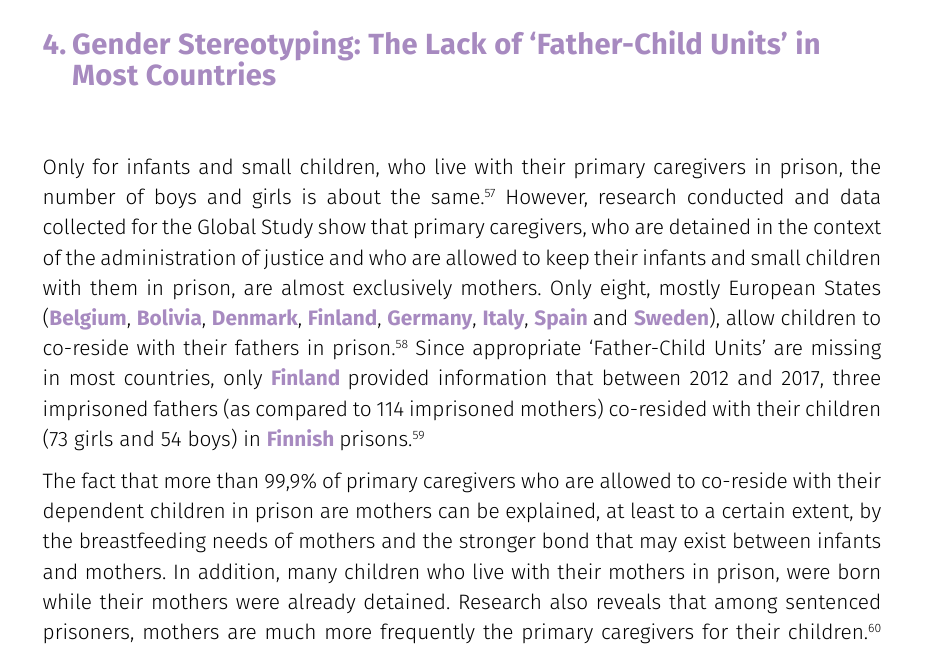
Rendered from the held copy of the 804-page volume, page 270. The full document is linked at the top of this page.
The child is the one with the right here. That is not a framing this site chose, it is the note's own: children of imprisoned caregivers are to be recognised as rights holders. A child whose mother goes to prison may, in most of the world, keep their parent. A child whose father goes to prison may not, in eighty-four of the ninety-two countries that answered.
Nothing here argues for fewer mother and child units. There is no version of this where a child is helped by another child losing something. The ask is a second room.
There is a UN Women. There is no UN Men. This is the ask, and it takes one tap.
— voices so far · one tap, anonymous, no signup
Questions this article answers
Can a child live with their father in prison?
In eight of the 92 states that answered the UN Global Study questionnaire: Belgium, Bolivia, Denmark, Finland, Germany, Italy, Spain and Sweden. Even in those eight, the study records that there are almost no suitable father-child units, so in practice it very rarely happens.
Which countries let children stay with an imprisoned father?
Belgium, Bolivia, Denmark, Finland, Germany, Italy, Spain and Sweden. Norway is not among them, nor are the other 84 states that answered.
Can children stay with their mothers in prison?
In most countries, yes. The UN study calculates that more than 99.9 per cent of primary caregivers permitted to co-reside with their children in prison are mothers. In Finland between 2012 and 2017, 114 imprisoned mothers co-resided with their children and three imprisoned fathers did.
Why are there no father and child units in prisons?
The UN study attributes it partly to real factors, breastfeeding, infant bonding, children born during detention, and mothers being more often the primary caregiver among sentenced prisoners. It then says the rate \u201calso reflects a certain gender stereotype\u201d, and that states find such units \u201cnot necessary or desirable\u201d.
Where this goes, and what would settle it
The test of everything above is a count. If a state that told the study it does not let a child stay with an imprisoned father has since opened a father-child unit, or if the Finnish prison service publishes co-residence figures that differ from the three and the 114 the study recorded, this article is wrong on that point and the correction goes in the log with the date.
The ask that follows is narrow: that co-residence is reported with the parent's sex attached, the way the study reported it once, and that a body exists whose job it is to receive that number and to notice when it does not move. Nothing here proposes closing a mother-child unit or moving a single child. The remedy for a stereotype the study itself named is a second wing, not a smaller first one.
The two documents this rests on
Both are public and both are linked here directly rather than described. Read them yourself. That is the point of putting them at the top of their own section instead of at the bottom of a reference list.
Full volume The United Nations Global Study on Children Deprived of Liberty, 804 pages, chapter 8 section 4 2019 Open it on childrendeprivedofliberty.info → A/74/136 Global study on children deprived of liberty: note by the Secretary-General 11 July 2019 Open it on documents.un.org →Source notes and accuracy flags
This section is part of the article, not an appendix to it. It records where each figure came from, what was checked, and every place where the honest version of a claim is weaker than the version that would have read better.
Source notes
- Both documents are held in this site's evidence archive with SHA-256 hashes, and both were re-fetched from their publishers and confirmed byte-identical to the copies read here. Page numbers refer to the PDF pages of the full volume, so a reader can jump straight to them: the eight states and the Finland figures are on page 270, the chart of the eight is on page 421, and the chapter contents listing section 4 by name is on page 256.
Every figure in this article also appears in the register, with its exact value and primary source, and any correction to it will appear in the corrections log with the date it was made.
0 visits · 0 read to the end
This page keeps four anonymous totals: pages loaded, read to the end, a source or receipt opened, and the support panel opened. No identifier is stored, repeats are limited by a salted network hash that expires in an hour, Do Not Track switches it off entirely, and the totals are public through the same API that serves them.