 UN for Men Too
Menu
Read
- Is there a UN for men? The short answers
- Gendered and raced at once
- Is it true?
- What countries have done
- The objections, answered
- UN Women and UN Men compared
- News, everything published here
- UN Women wrote that men die younger. Then handed them a reading list about someone else.
- UN for Men? They wrote it down in 2004.
- One life, in the numbers that exist
The evidence
- The Archive: men's statistics, every cell sourced
- The register: every claim and its source
- The gap, in one picture
- The machinery: markers, outcomes and parity, live
- Why fathers matter
- Male suicide
- Family law and Article 8
- Boys and education
- Violence against men and boys
- The pushback, documented
- The research agenda
The ask
Language
UN for Men Too · article
The half that always goes
The UN's own study says boys face discriminatory treatment. The version sent to member states left that out.
Chapter 8 of the UN Global Study on Children Deprived of Liberty opens by saying that boys often face discriminatory treatment and are overrepresented everywhere, because of stereotypes about how violent they are. The 23-page note that went to the General Assembly keeps the striking number, 94 per cent of detained children are boys, and drops the finding. Its recommendations chapter drops the word boys altogether. Three stages of one study, and the same half goes at every step.
A minimum of 1.3 million
The study runs to 804 pages and the number everyone quotes is on page nine. The sentence fifty-one paragraphs earlier is the one nobody quotes.
In December 2014 the General Assembly invited the Secretary-General to commission an in-depth study on children deprived of liberty. Manfred Nowak was appointed to lead it in October 2016, and the result was transmitted to member states on 11 July 2019 as A/74/136. It is the most complete count anyone has of the children the world locks up. The headline number is in paragraph 86: a minimum of between 1.3 and 1.5 million children deprived of liberty every year. Institutions hold the largest share, then the administration of justice, then migration detention, then armed conflict. That is the figure the coverage led on, and it deserved to.
Fifty-one paragraphs before it, on page nine, there is a section headed Gender dimension. It is four paragraphs long. This is the first of them, in full.
The data collected for the study indicate significant gender disparities in the situation of children deprived of liberty. Altogether, there are far more boys deprived of liberty worldwide than girls. In the administration of justice and in the contexts of armed conflicts and national security, 94 per cent of all detained children are boys; in migration detention the figure is 67 per cent and in institutions it is 56 per cent.
Ninety-four per cent. Not a campaign's figure. Not an advocacy group's estimate. A study commissioned by the General Assembly, delivered by an Independent Expert, transmitted by the Secretary-General, and sitting on page nine of a twenty-three page document that member states were sent.
Who gets diverted
A study that counts is useful. A study that explains is dangerous. This one explains, and one of its explanations is a word you would not expect a UN document to print.
The next paragraph asks why. It gives a funnel: girls are attributed roughly a third of all criminal offences committed by children worldwide, and receive 6 per cent of prison sentences. It then lists reasons, and it lists them fairly. Girls commit less violent offences. Girls are more often accused of status offences. Girls are generally first-time offenders and, in the study's words, more receptive to the deterrent effect of incarceration. Those are real and they are not disputed here. But the study does not stop there.
Another explanation is the “chivalrous and paternalistic” attitude of many male judges and prosecutors in the child justice systems, who assume, according to traditional gender stereotypes, that girls are more in need of protection than boys.
Read that again with the campaign's usual framing removed. A UN study is saying that a gender stereotype produces a worse outcome for boys, and naming the mechanism: adults in the system assume boys need less protecting. That is a finding about how a stereotype harms the sex it is supposed to flatter, written down by the United Nations, in 2019.
One paragraph later, a second finding, this one about fathers. Most states allow a convicted mother to keep her young child with her in prison. The study reports that only eight states explicitly permit a father to do the same, and that even where it is permitted there are almost no father and child units, so in practice it does not happen.
Now the part this site is obliged to print, because the same document says it and leaving it out would make this article the thing it is criticising. Paragraph 38 is about girls, and it is not a footnote.
While boys are overrepresented in detention, girls often suffer gender-based discrimination. Research conducted for the study shows that girls are more likely to be arrested for status offences, for behaviour rather than actual criminal activity, including sexual activity, truancy and running away from home. […] In detention, girls are particularly vulnerable to sexual and other forms of violence.
Paragraph 39 does the same for LGBTI children, who it reports are overrepresented in child justice facilities, placed in unsuitable facilities and particularly vulnerable to violence. Both paragraphs are true, both matter, and neither is in tension with the 94 per cent. A group can be the overwhelming majority of a detained population and other groups can still face distinct harms inside it. The study holds both. So does this article.
Except that it does not hold them the same way, and the reason took me to a second document. Behind the twenty-three page note there is the study itself: 804 pages, published in 2019 under Manfred Nowak's name. Its chapter 8 is called Gender Dimension, and it opens like this.
This chapter shines a spotlight on the fact that boys often face discriminatory treatment and are over represented in all situations of deprivation of liberty due to stereotypical views on the propensity of boys towards violent behaviour.
Boys often face discriminatory treatment. That is not this campaign's phrasing. It is the study's, in the opening line of the chapter where it examines sex. It names the mechanism too: stereotypical views about how violent boys are.
Now search the note that was sent to member states for that finding. Discriminatory treatment does not appear in it. Neither does stereotypical views, nor propensity, nor the spotlight the chapter says it is shining. What survived the journey from the study to the General Assembly is the number, 94 per cent, and the word that explains it, chivalrous. The finding that boys face discriminatory treatment did not make the summary.
The dropped phrases, counted in both documents
- “discriminatory treatment”: 2 → 0
- “stereotypical views”: 1 → 0
- “harsher treatment”: 2 → 0
- “not against boys”: 1 → 0
- “discrimination against boys”, the section heading's own words: 4 → 0
- “chivalrous”, which survived: 1 → 1
- the 94 per cent figure, which survived: 94% → 94 per cent
Each row is a whole-text search of the two documents linked at the end of this page: first count in the 804-page study, second in the 23-page note A/74/136. Counted from the held PDFs on 21 August 2026, case-insensitive, whitespace-normalised, and recorded in the fact register the same day. One caution for anyone re-running it: the study writes the figure as 94% and the note as 94 per cent, so the search string decides which zero you see. The counts say what is present and absent; they do not say who cut what, or why.
The chapter does not bury it, either. Its second section carries a heading of its own, listed in the study's contents: Discrimination against Boys. Under that heading the study writes a sentence that almost nobody in this field writes down.
Most research on the gender dimension of deprivation of liberty relates to the administration of criminal justice and primarily addresses cases of discrimination against girls, not against boys.
That is the argument this campaign exists to make, printed inside a UN study, under a heading, with footnotes. The research addresses discrimination against girls, not against boys. It is not written as an accusation. It is written as a description of the literature the study had just finished reading. The chapter goes further and reproduces, at length, an academic's judgement that the children's rights movement itself avoids the question, a passage the study chose to quote rather than to answer.
The same attenuation shows up in what each document says about violence. In the note there are twenty sentences mentioning violence: eighteen about children generally, two naming girls, none naming a boy, a male, a man, him or his. In the full volume there are 450, and nine of them do name boys. So the study is not silent. It records a boy beaten with a wooden stick until he nearly lost an eye, and it records this:
Although less information is available, boys are also subjected to sexual violence while in detention.
Read the first clause again. The study is not only reporting a harm to boys, it is reporting that less is known about it, which is the entire argument of this website written by the people who did the counting. And that sentence, like the discriminatory treatment sentence, is not in the note either.
So paragraph 38 is not the balance it reads as, and the reason is now visible in three stages of one study. The 804-page volume says boys face discriminatory treatment and that less is known about violence against them. The 23-page note to member states keeps the 94 per cent and drops both. The recommendations chapter inside that note drops the word boys altogether. Each step is shorter than the one before, which is what a summary is for. But at every step it is the same half that goes.
I want to be careful about what this does and does not show. Nothing here says girls are not at particular risk in detention; the volume documents that at length and in more detail than it documents boys, and some of that gap is the study telling you honestly that the research does not exist. Nothing here says anyone dropped anything on purpose. I do not know why the sentence went, and neither does anyone who has not seen the drafting. What is checkable is that it went.
Then it wrote the recommendations
Every finding above should now turn into an instruction to somebody. Except this is where the trail stops, and it stops in the same place every time.
A study like this ends by telling states what to do. In A/74/136 that is chapter VIII, running from paragraph 98 to the end of the document, about sixteen thousand characters of general and situation-specific recommendations. I extracted it and counted whole words in it.
What the study found, and what it went on to ask for
Found, in the body
- 0194 per cent of children detained in the administration of justice, armed conflict and national security are boys.
- 02Girls are attributed about a third of offences and receive 6 per cent of prison sentences.
- 03A “chivalrous and paternalistic” assumption that girls need more protection than boys.
- 04Only eight states explicitly let a father keep his child with him in prison.
- 05Boys are, in the study's own words, “above all” overrepresented in detention.
Asked for, in the recommendations
- A recommendation naming boys
- A diversion target for boys
- A disaggregation duty by sex
- A father and child unit
- An indicator
- A follow-up owner
5findings about boys in the body of the study
0times the word boys appears in the recommendations
A/74/136, chapter VIII, Recommendations, counted from the extracted text on 18 August 2026unformentoo.org
The chapter is not silent on sex. It contains the word girls once, in a recommendation about children associated with armed forces and armed groups, asking that assistance take account of their specific situation and needs and provide tailored measures. That recommendation is good. It should be there. It is also, precisely, the thing that did not get written for the 94 per cent.
The number is in the study. The number is not in the ask.
There is a further document inside the document, and it changes what this section can claim. Chapter 8 does not only make findings. It closes, on page 275, with seven recommendations of its own, introduced as aiming to assist States to eliminate gender gaps and discrimination on the basis of sex. The second reads, in full:
Address the overrepresentation of boys in detention by various means, above all by promoting diversion at all stages in the criminal justice system and by proportionally applying non-custodial solutions to boys, as it is more widely practised with girls.
So the ask exists. It was written by the people who did the counting, it names boys, and it tells States what to do about them. It is not that nobody asked. It is that the ask did not travel. Chapter 8's own recommendations name boys four times. The recommendations that reached the General Assembly name boys no times.
There is one subject where the two documents can be laid directly on top of each other, because both examine it and both arrive at a recommendation about it. Diversion is the decision to deal with a child outside the courts, and it is the difference between a criminal record and none. Paragraph 36 of the note reports the disparity itself.
Compared with the overall crime rate for children, the data gathered for the study show a tendency of the child justice system to be more inclined to apply diversion measures to girls than boys.
The full study then says what should be done about it, in one sentence, naming both.
Diversion measures should equally be applied to boys and girls and be appropriate to the child’s age, level of maturity, as well as the situation in the community.
The note’s recommendation on diversion reads, in full: States should prioritize restorative justice, diversion from judicial proceedings and non-custodial solutions. The word equally is gone, and so are boys and girls. The word equal does survive into that chapter, once, in a recommendation that girls associated with armed forces be guaranteed equal access to rehabilitation and reintegration. That recommendation belongs there. So did the other one.
I want to be careful about what this does and does not show, because the easy version of this paragraph is wrong. The recommendations are largely written for all children, and boys are children, so they are covered by construction. Nobody is excluded. That is a fair reading and I am not going to pretend otherwise. But universal coverage is what the rest of this site keeps running into. A recommendation that covers everyone assigns nothing to anyone. When the study wanted a group's needs taken into account specifically, it knew exactly how to say so, and it said so for girls in armed conflict. It had the same sentence available for the group that is 94 per cent of the population it had just measured, and it did not write it.
This is not a failure of noticing. The noticing is the best thing in the document. It is a failure of the step after noticing, which is the step this campaign is about.
The receipts
The passages quoted above, cut out of the pages they are printed on. Click any of them to open it full size. Nothing here is retyped and nothing is cropped tighter than the sentence needs.
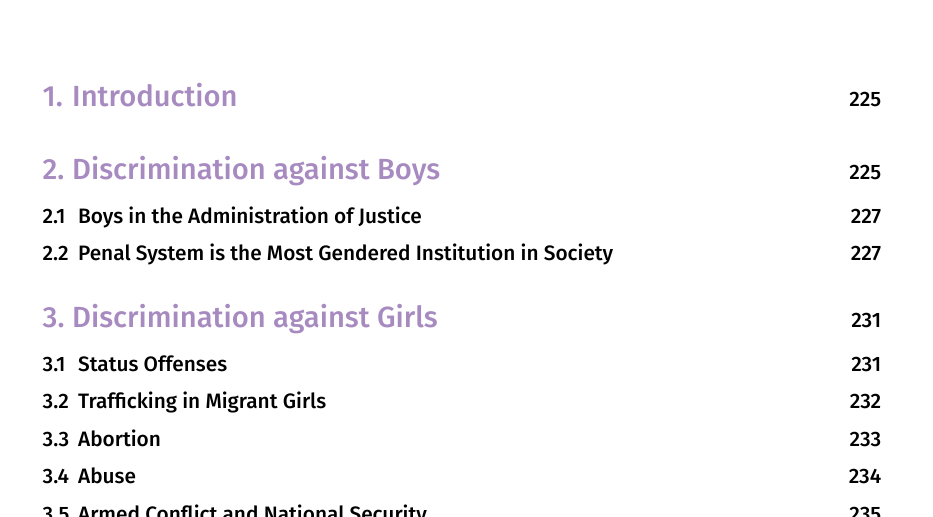 UN Global Study on Children Deprived of Liberty, page 256
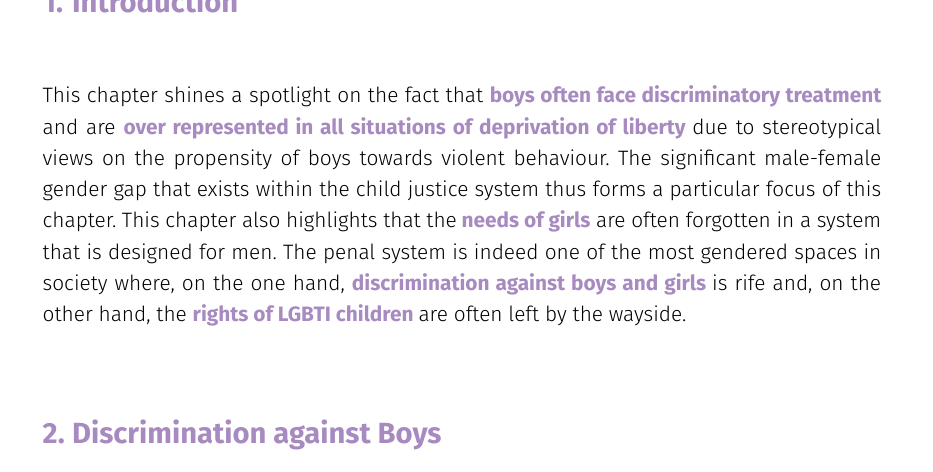 UN Global Study on Children Deprived of Liberty, page 257
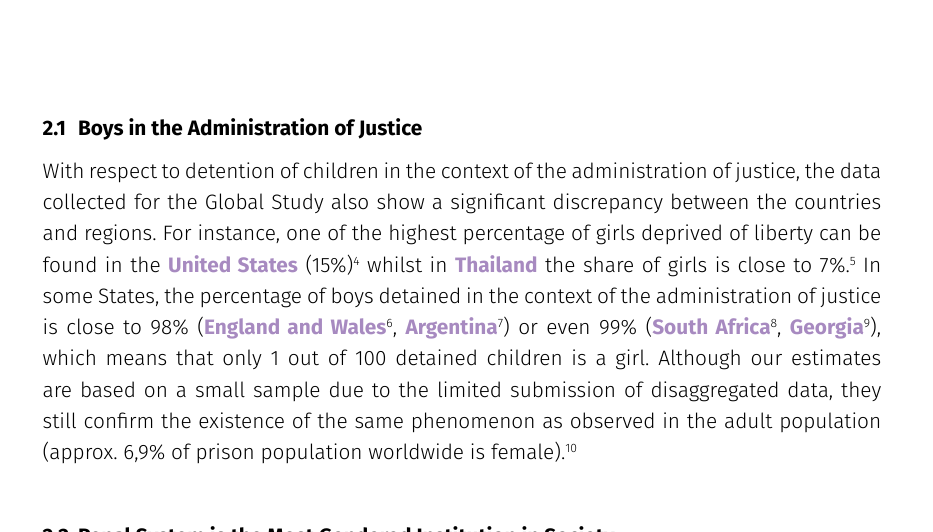 UN Global Study on Children Deprived of Liberty, page 259
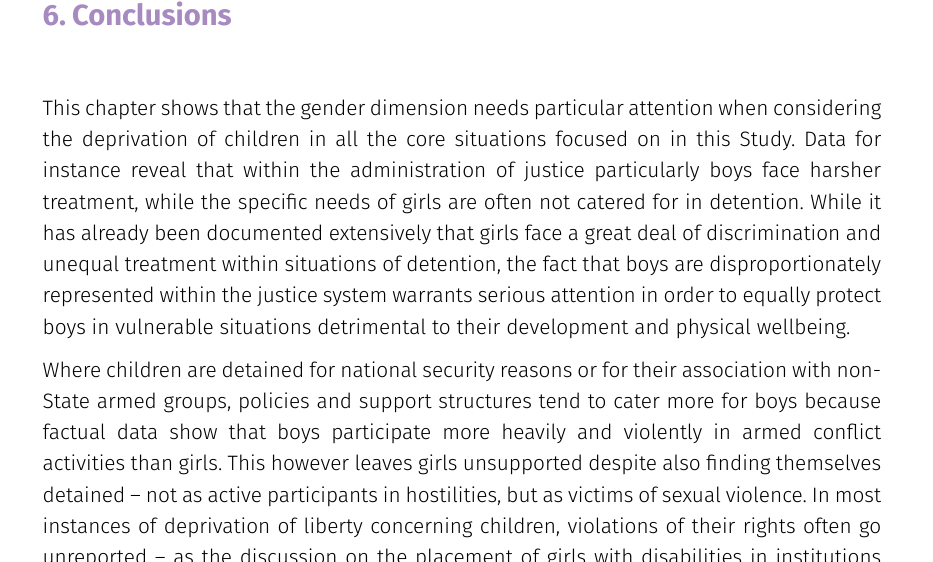 UN Global Study on Children Deprived of Liberty, page 274
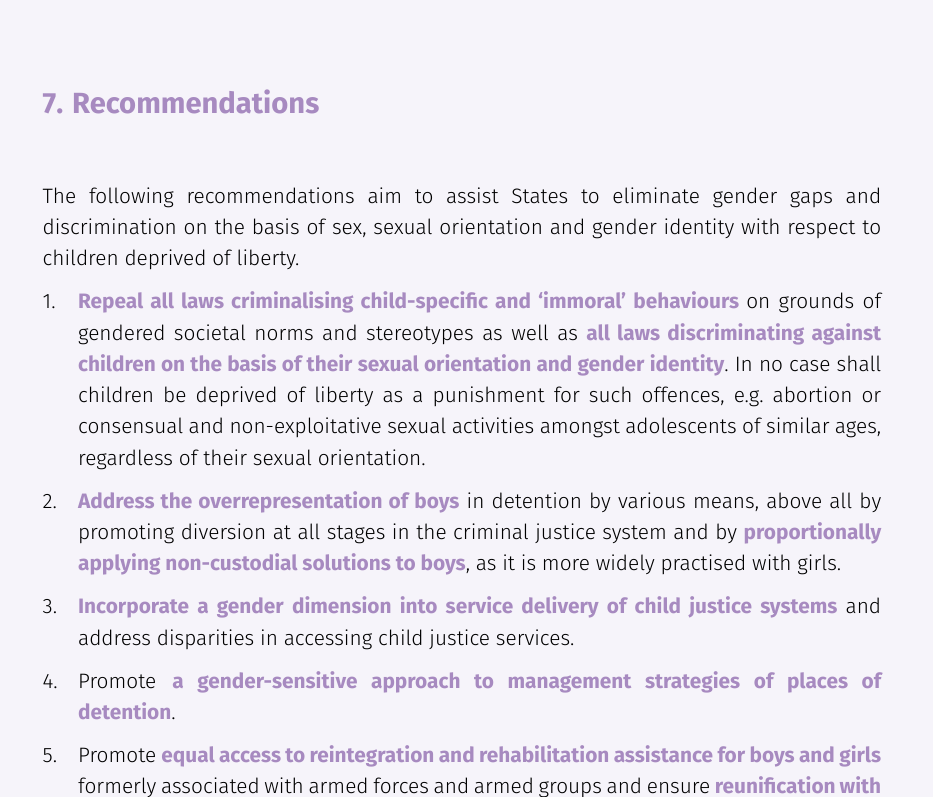 UN Global Study on Children Deprived of Liberty, page 275
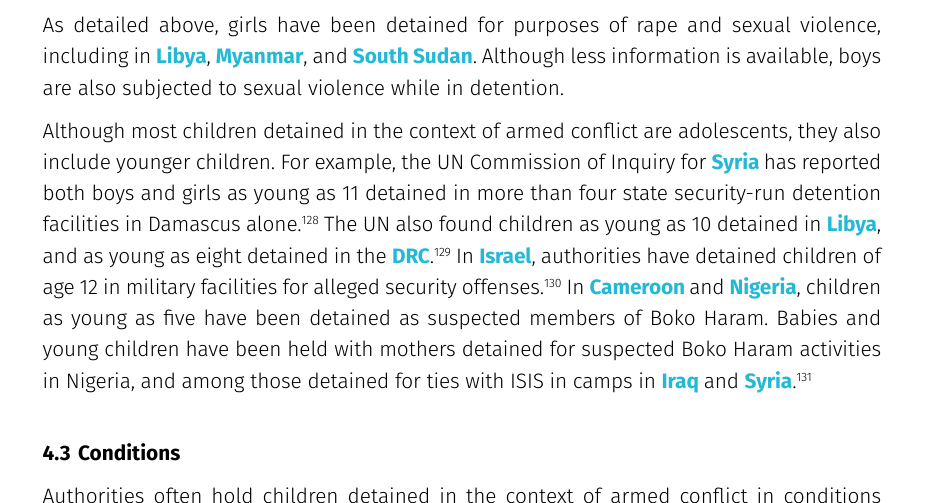 UN Global Study on Children Deprived of Liberty, page 628
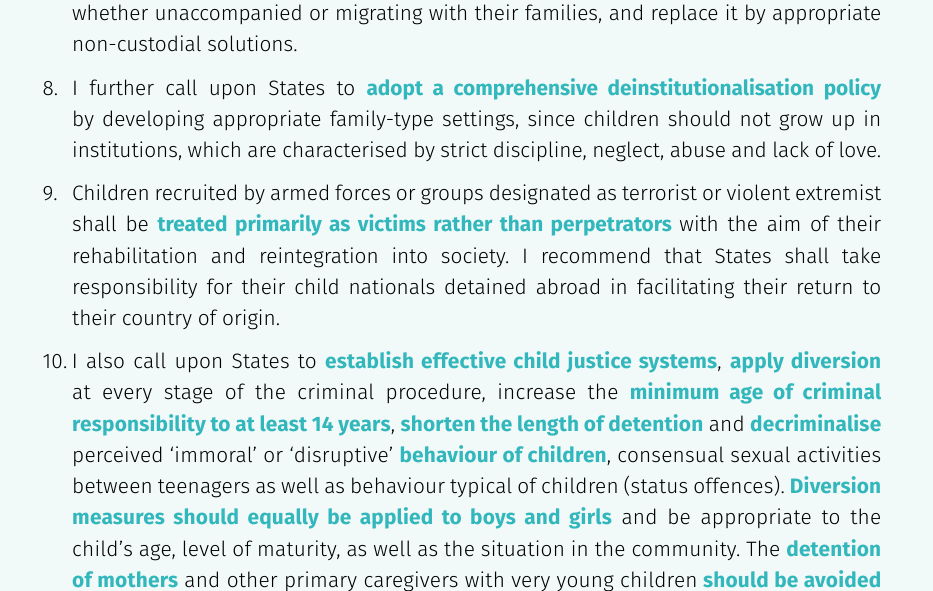 UN Global Study on Children Deprived of Liberty, page 701
Rendered from the 804-page volume held in this site's evidence archive, whose SHA-256 matches the copy the publisher serves today. The whole document is linked at the top of this page if you would rather read around them.
There is a way to see this that does not depend on reading either document sympathetically. Count the words in the recommendations chapter of the note.
How the recommendations chapter names children
2,316 words of recommendations transmitted to every member state. Three ways of referring to the people they are about.
-
“children”, the general term65
-
“girls”, named as a group1
-
“boys”never named
Boys were not removed and replaced with nothing. They were absorbed into the word children. Girls were not.
The single mention is this: assistance to children formerly associated with armed forces “should take into account the specific situation and needs of girls associated with armed forces and armed groups in order to guarantee equal access to rehabilitation and reintegration assistance, as well as tailored measures”.
That is a good provision and it should be there. Girls in armed groups have specific needs and naming them is how a recommendation reaches them.
The point is what the study's own version of that same recommendation said. Chapter 8, recommendation 5: “Promote equal access to reintegration and rehabilitation assistance for boys and girls formerly associated with armed forces and armed groups.”
Both sexes named in the study. In the version sent to member states, one sex generalised into children and the other kept, with tailored measures attached.
That is the mechanism in a single paragraph, and it is not an accusation about anybody's intent. It is a word count, and anyone can run it.
There is one defence of all this that deserves a proper answer, because it is the reasonable one. Eight hundred pages into twenty-three means cutting almost everything. Findings are lost in every summary ever written, and losing some about boys proves nothing on its own.
That defence is testable, and the test is symmetric. Chapter 8 has a section on discrimination against boys and a section on discrimination against girls. If the compression was neutral, findings from both should have fared about the same.
The same chapter, the same edit, two sets of findings
Six specific findings about girls and five about boys, each taken from chapter 8, each searched for in the note transmitted to the General Assembly.
-
Girls findings that survived6
of 6 tested
-
Boys findings that survivednone survived
of 5 tested
The girls findings are all there. Status offences, and girls arrested for behaviour rather than crime. The chivalrous and paternalistic attitude of judges. Girls suffering gender-based discrimination. Trafficking of migrant girls. Girls associated with armed forces, seven separate times. The assumption that girls need more protection than boys.
Not one of the boys findings is. Not the discriminatory treatment. Not the stereotypical views about propensity to violence. Not the harsher treatment. Not the sentence about research addressing girls rather than boys. Not the section heading.
Six out of six on one side. Nought out of five on the other. Same chapter, same editor, same twenty-three pages.
That is what closes the compression argument. A summary that dropped material from both sections would be a summary. This one kept one column and lost the other, and the reader can run the search and see it.
It still says nothing about why, and this article still does not claim to know. What it establishes is narrower and harder: whatever happened, it did not happen evenly.
So what would have been enough? One sentence. A recommendation, in chapter VIII, asking states to address the overrepresentation of boys by extending to them the diversion measures the study had just shown are more readily applied to girls. It would have cost the study nothing, it would have taken nothing from girls, and it would have given the 94 per cent somewhere to go.
Instead the figure sits in paragraph 35, where it has sat since July 2019, correct and unattached. Seven years. I have not found a later UN document that picks it up, and I have looked; if one exists I want to be sent it and I will print the correction.
There is a version of this article that is angry at the Independent Expert, and it would be stupid. He is the reason the number exists. The people who counted the boys are not the people who failed them. The gap is between the counting and the asking, and there is nobody standing in it.
There is a UN Women. There is no UN Men. This is the ask, and it takes one tap.
— voices so far · one tap, anonymous, no signup
Questions this article answers
What percentage of children in detention are boys?
94 per cent in the administration of justice and in the contexts of armed conflict and national security. In migration detention the figure is 67 per cent, and in institutions it is 56 per cent (A/74/136, paragraph 35). The 94 per cent is often quoted as if it covered all detention, and it does not.
Does the UN say boys face discrimination?
Yes. The full UN Global Study on Children Deprived of Liberty states that boys \u201coften face discriminatory treatment\u201d and are overrepresented in all situations of deprivation of liberty \u201cdue to stereotypical views on the propensity of boys towards violent behaviour\u201d. Chapter 8 has a section headed Discrimination against Boys.
What is A/74/136?
The 23-page note by the Secretary-General transmitting the Global Study on Children Deprived of Liberty to the General Assembly, dated 11 July 2019. The study behind it runs to 804 pages. Both are linked in full on this page.
Are boys treated more harshly than girls in the justice system?
The UN study says so directly: \u201cparticularly boys face harsher treatment, while the specific needs of girls are often not catered for in detention\u201d. Its own recommendation asks states to apply non-custodial solutions to boys \u201cas it is more widely practised with girls\u201d.
Where this goes, and what would settle it
The straightforward test of everything above is whether any UN document after July 2019 carries the 94 per cent into a recommendation, a target or an indicator. If one does, this article is wrong in its central claim and will say so in the corrections register with the date.
The ask that follows from it is small and specific: that the disaggregation the study performed becomes something states are asked to report, and that a body exists whose job it is to receive it. Nothing here proposes taking anything from girls or from any other group in that document, and the initiative says so wherever it describes itself.
The two documents this rests on
Both are public and both are linked here directly rather than described. Read them yourself. That is the point of putting them at the top of their own section instead of at the bottom of a reference list.
A/74/136 Global study on children deprived of liberty: note by the Secretary-General 11 July 2019 Open it on documents.un.org → Global Study The United Nations Global Study on Children Deprived of Liberty, full volume, 804 pages 2019 Open it on childrendeprivedofliberty.info →Source notes and accuracy flags
This section is part of the article, not an appendix to it. It records where each figure came from, what was checked, and every place where the honest version of a claim is weaker than the version that would have read better.
Source notes
- Both documents were downloaded and read here: the 23-page note A/74/136 and the 804-page full study volume. Both are held in this site’s evidence archive. Every count in this article was produced from the extracted text of those files, not from a summary of them.
- A/74/136 was downloaded and read in full on 18 August 2026 before this was written, and the copy is held in this site's evidence archive with its SHA-256 recorded in the manifest.
- The sentence counts in section two were produced by splitting the extracted text on sentence boundaries and matching whole words. Twenty sentences contain a form of the word violence; two of those name girls and none names boys, males, men, him or his. Seven sentences contain the word boys; all seven were read individually rather than classified by pattern, and every one concerns how many boys are detained or why, not what happens to them in detention.
- The word counts in this article were produced by extracting the document's text and counting whole words with letter boundaries, not by reading and estimating. The Recommendations chapter was taken from the heading “VIII. Recommendations” to the end of the document, 15,969 characters. Counting from the earlier table-of-contents entry instead gives a different and wrong answer, which is a mistake I made first and corrected.
- This article quotes the note transmitted to the General Assembly, not the full study volume behind it. Where the two differ in wording, the transmitted note is the text member states received.
Every figure in this article also appears in the register, with its exact value and primary source, and any correction to it will appear in the corrections log with the date it was made.
0 visits · 0 read to the end
This page keeps four anonymous totals: pages loaded, read to the end, a source or receipt opened, and the support panel opened. No identifier is stored, repeats are limited by a salted network hash that expires in an hour, Do Not Track switches it off entirely, and the totals are public through the same API that serves them.