 UN for Men Too
Menu
Read
- Is there a UN for men? The short answers
- Gendered and raced at once
- Is it true?
- What countries have done
- The objections, answered
- UN Women and UN Men compared
- News, everything published here
- UN Women wrote that men die younger. Then handed them a reading list about someone else.
- UN for Men? They wrote it down in 2004.
- One life, in the numbers that exist
The evidence
- The Archive: men's statistics, every cell sourced
- The register: every claim and its source
- The gap, in one picture
- The machinery: markers, outcomes and parity, live
- Why fathers matter
- Male suicide
- Family law and Article 8
- Boys and education
- Violence against men and boys
- The pushback, documented
- The research agenda
The ask
Language
UN for Men Too · article
The empty class.
We read every aid project Norway funded in 2023 that mentions men. The class of projects FOR men does not exist. Not small. Empty.
This is the article we did not expect to write this starkly. We pulled every project in Norway's 2023 country-allocable aid microdata, found every one whose text names men, boys, husbands or fathers, and read all of them under rules published before the reading. The class we were testing for, projects aimed at men's or boys' own outcomes, is not underrepresented. It is empty. What follows is the count, the receipts you can open, and the two scenarios that explain how a portfolio gets a zero in it, only one of which survives the evidence.
The count that should not be possible
A donor with a men's equality commission, counted honestly, has zero aid projects aimed at men. Read that twice, then check our work.
OECD CRS project microdata via the public SDMX API, swept 20-21 August 2026, every file hashed in the receipts manifest.
Here is the sentence that made us re-run the count before believing it: in eleven and three quarter billion dollars of Norwegian aid projects, there is not one whose text aims at the outcomes of men or boys. Not one suicide project for the sex that carries most of the suicides. Not one boys' education project outside a girls-titled programme that includes them. Not one men's health line. The word men appears, 232 times. It appears in lists, in boilerplate, and in projects that engage men for someone else's outcome. As a destination, never.
We are aware how that reads. It reads like a claim built to provoke, so the whole apparatus of this site stands behind it in public: the sweep recipe, the hashed file manifest, the classification rules published before the reading, and all 71 verdicts, one by one, in the research record. If one call is wrong, name it, and the correction goes up dated and credited. The count survived our own checks on any result that looks too clean, a full re-run and a recount against the raw rows, which have killed findings of ours before. This one it did not kill.
How we counted, so you can recount
Rules first, reading second, verdicts public. The hypothesis was registered before the data could answer.
The method is the one this site always uses: complete enumeration rather than sampling. Word-boundary matching, with male never matching inside female and men never inside women. Every match read in context: title, short description, long description. And a hypothesis stated in the research record before any reading began: that among projects naming men, more would treat them as instruments for someone else's outcome than as beneficiaries of their own. Stated so the data could contradict it.
The data did contradict it, in the one direction we did not predict. The instrument class is real: seven projects clearly, four more leaning, husbands engaged so women can access reproductive health, masculinity workshopped to bring down HIV and violence, men reached so equality advances. The generic class is the biggest: forty-eight projects where men appear in a list or a boilerplate line. The inclusive class exists: four projects serving women and men on equal terms. The beneficiary class, a male-directed project for male outcomes, which we expected to find small, we found empty. Six texts truncate too early to call, and none of the six reads male-directed in its visible part; they are flagged, not counted.
One year, one donor, country-allocable grants: those are the boundaries, stated. The Nordic sweeps running now will show whether the shape repeats. The classification file, the rules, and every text are in the open, and re-judging our calls requires nothing but reading.
And because seventy-one verdicts stand on one reader, here is the ceiling computed against ourselves, the highest count a reader hostile to our conclusion could defend: flip every contested call, all eleven instrument reads, both mixed, all six unclears, even the four both-sexes projects, and the male-directed class is at most 23 of 7,270 projects, 0.32 percent, against 1,078 principal-marked for the other column. The zero is our reading; the ceiling survives any re-reading. Both are published, and the texts are open for anyone to re-judge.
The matcher's language coverage is stated and was audited after a reviewer asked: Norwegian terms (menn, gutter, fedre) return zero additional projects in the Norway corpus, and a multilingual pass over the world file (hommes, garçons, hombres, männer, mænd, and eleven more terms) surfaced 837 additional texts, which were triaged under the same published rules and top-read by value: all enumerations and instruments, no male-directed project among them either.
The two scenarios
A zero like this has exactly two candidate explanations. The evidence keeps one.
Scenario one: somebody decided. A decision to exclude men would need deciders, and deciders leave records: a policy stating the exclusion, a memo, a vote, a refused application trail. We have hunted for that record across this whole project, because it would be the story of the decade, and it does not exist. No document in the UN system, the OECD system or the Norwegian system says do not fund men's outcomes. The strongest version of scenario one that survives contact with the sources is not a villain but a frame, and the frame has a date and a receipt, which brings us to scenario two.
Scenario two: nobody was assigned, and the frame did the rest. Follow the machinery of how any aid project is born. An entity exists, so strategies exist. Strategies exist, so funding calls exist. A marker exists, so the money can be counted, and what is counted gets managed. Norway applies the OECD gender marker to every project, its strategy documents carry gender objectives, and the result is 1,078 principal-marked projects worth 570 million dollars, flowing to named channels. Every station of that chain is sourced on this site, and every station works. Now run the same chain for men: there is no entity, so no strategy names men's outcomes, so no call asks for them, so no marker counts them, and a men's project would have to be born by accident. Portfolios do not produce accidents at scale. The predictable output of that chain is exactly zero, and zero is what the data shows.
The two chains, drawn
How a project is born, station by station. Read the right-hand column of each row, then read where the stations live: every keeper is a UN or OECD institution. Norway is where we measured the output. The chain that produces the output is global.
-
For women and girls, the chain that produced 1,078 projects
- 01 A body exists UN Women, GA resolution 64/289
- 02 A frame says what men and women are for ECOSOC agreed conclusions, 2004
- 03 The money is counted OECD DAC gender equality marker
- 04 Strategies name the outcomes donor gender strategies, downstream of all three
- 05 Calls ask for projects agencies and NGOs answer the strategies
- 06 The portfolio fills 1,078 principal projects, $570M, Norway 2023
-
For men and boys, the same chain
- 01 A body exists nobody
- 02 A frame names their outcomes nobody
- 03 The money is counted nobody
- 04 Strategies name the outcomes nobody
- 05 Calls ask for projects nobody
- 06 The portfolio fills 0 projects, any donor we have measured
And read where every station of the working chain lives, because this is the part that keeps this from being a story about Norway. The entity is the General Assembly's. The frame is ECOSOC's. The marker is the OECD's. The strategies and calls are downstream of all three. Norway is not the mechanism; Norway is the best-lit place to photograph the mechanism's output. Change the Norwegian government tomorrow and the chain upstream is untouched, which is why the letters went to the chain's owners, not to Oslo. The Nordic sweeps running now are the test: if the upstream chain is the cause, the same zero appears in Copenhagen, Stockholm and Helsinki, and wherever else the chain reaches.
The two scenarios are testable against the record, and the record keeps the second. The empty class is not a decision anyone made in 2023. It reads as the running output of a frame that was written down in 2004, in a document you can open below; if that reading is right, the Nordic sweeps will find the same zero.
Twenty-two years ago, in their own ink
The system did take up men and boys, once, at the highest level. Read what it wrote them down as.
In 2004 the Commission on the Status of Women adopted, and the Economic and Social Council endorsed, agreed conclusions on the role of men and boys in achieving gender equality. That is the system covering men and boys, twenty-two years ago, in a text this site holds. The receipts below are photographs of its ink.
The 2004 frame, receipted
Three passages from the endorsed text, and the resolution that later built the women's entity. Click any receipt to open it full size; the held documents are linked beneath.
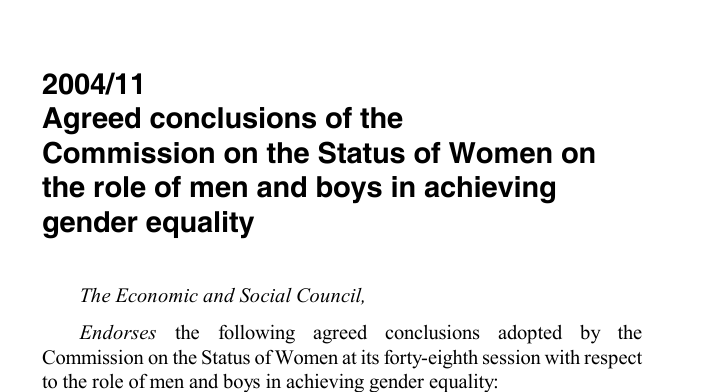
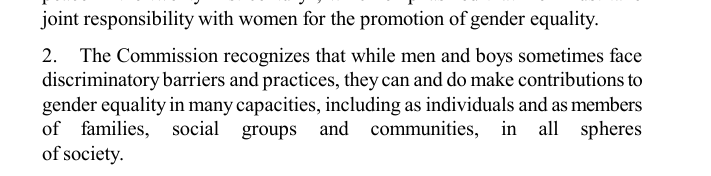
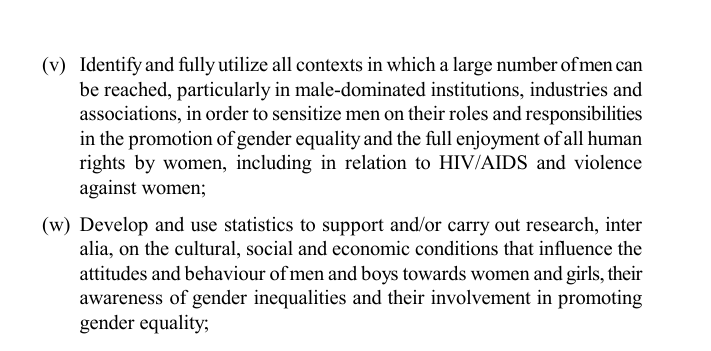
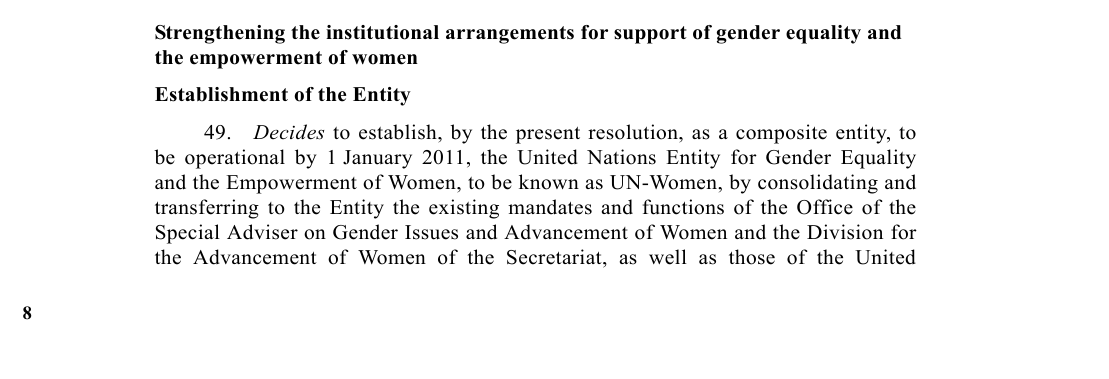
Read paragraph 2 the way a portfolio manager would. Men's and boys' barriers are acknowledged, in a subordinate clause, and the sentence lands on what men can contribute to gender equality. Then read items (v) and (w), the operative machinery: contexts where large numbers of men can be reached, in order to sensitize them; statistics to be developed about men's attitudes and behaviour towards women and girls. The statistics the 2004 text orders up about men are about their attitudes. Statistics about their outcomes, their suicides, their schooling, their deaths at work, appear nowhere in the operative list.
That is the frame, at its birth, in its own words. It is not a villain's document; it reads as its era wrote, and the work it commissioned was real. But a frame that files men under contributions-to-others cannot generate a project that files them under outcomes-of-their-own, and nineteen years later, in a diligent donor's diligent data, the class that frame never created is still empty. The 2023 zero matches the 2004 sentence, two decades on; whether the sentence caused it is exactly what the Nordic sweeps test.
And this is precisely why none of it indicts the machinery that exists. The machinery did what machinery does: it ran its instructions. The women's chain it was built to run works, measurably, and this site documents that with admiration in its own article. The finding is not that the machine is broken. The finding is that in 2004 the system said men and boys too, and then nobody was ever assigned to build their half, which is this site's entire subject, found once more, this time at the bottom of a donor's ledger.
The world test, run the same day
The bulk files arrived, so we asked the planet the Norway question. Updated 21 August 2026.
Triage rules published, survivors human-read, excluded pool sampled; the full corpus is held so that anyone, critics included, can replicate the classification.
The world result is better than Norway's zero for exactly one reason: it is not zero, and the exceptions deserve their names. The United States funds the planet's only at-scale male-directed service, voluntary medical circumcision under its HIV programmes, 61.8 million dollars of surgery that protects the circumcised man himself. The United Kingdom funded the only project on earth we can find for male survivors of sexual violence, fifty thousand dollars, in Colombia, and a six-thousand-dollar men's health-literacy pilot in Mozambique. Canada funded seventy thousand dollars of MSM health in Nairobi. Spain, three thousand dollars of media literacy for men in prison. That is the list. All of it.
Set the two columns side by side, world scale. Norway alone runs 570 million dollars of gender-principal projects. The entire planet's male-beneficiary class in grant aid, counting the circumcision programmes, is 61.9 million, and 99.8 percent of it is one clinical procedure from one donor. Excluding it, the world total is 129 thousand dollars: roughly one dollar in every two million of aid. The 2004 frame did not produce a Norwegian anomaly. It produced a planetary architecture, and the four micro-projects are what individual programme officers manage to do inside it, which is why they get named and thanked rather than counted against.
The Nordic position, and the clock on the letters
Where the documentation is best, the vacancy is clearest. And the people who could fill it have mail waiting.
We swept Norway first for a reason this site keeps stating: nowhere documents itself better, and best-documented is the only fair place to test a hard claim. This is the state with the world's only broad men's equality commission report, thirty-five proposed measures, a state-funded men's resource centre, and full policy-marker reporting. If the beneficiary class is empty here, of all places, the vacancy is structural, not a local oversight. Denmark's sweep is running as this publishes; Sweden, Finland and Iceland follow, every file hashed, and whatever the shape turns out to be, it gets published, including if a Nordic neighbour proves us wrong and fields a real male-directed portfolio. We would celebrate that correction, because it would be a working model to point at.
Meanwhile the question underneath all of this sits, in writing, on the desks of the people who own the frame. The letters went out on 19 August asking the system's own bodies the smallest checkable versions of it: a marker, an indicator, a named paragraph, a mandate. Replies are due 9 September 2026, every reply publishes in full, and silence becomes a dated sentence. The first two responses arrived within a day, both polite redirects to other desks, and both are logged: the fourth branch, forwarded, which is itself a data point about a question no desk owns.
One class is empty. One chain works. One frame is twenty-two years old, and its owners have three weeks left on the clock.
The word men appears 232 times in the ledger. As a destination, zero. The machine is not malfunctioning. It was never given the address.
Seven thousand two hundred and seventy projects. Two hundred and thirty-two mentions. Seventy-one read one by one. Zero for men's own outcomes, and a 2004 document that explains the zero without a villain: the frame files men under what they can do for equality, and no one was ever assigned to file them under what happens to them.
We went looking for the smallest class in the portfolio. We found out it was never created.
There is a UN Women. There is no UN Men. This is the ask, and it takes one tap.
— voices so far · one tap, anonymous, no signup
Questions this article answers
Does Norway fund any aid projects for men and boys?
None whose text is directed at men's or boys' own outcomes, in the 2023 country-allocable grant microdata. The boundary matters: the sweep sees projects through their text, so a project that serves mostly men without ever naming them is invisible to it, and the stated assumption is that a project directed at men would name them, the way every women-directed project names women. Among the 71 that do name them: 48 generic mentions, 11 engaging men for other outcomes, 4 both-sexes projects, 2 mixed, 6 too truncated to call, and zero directed at men.
Is that because someone decided to exclude men?
No record of any such decision exists, and we hunted for one. The receipted explanation is a frame: the 2004 UN text on men and boys files them as contributors to gender equality, orders statistics about their attitudes towards women, and never creates outcome machinery for them. A portfolio downstream of that frame predictably produces zero male-directed projects.
Does this mean the gender-equality machinery does not work?
The opposite: the same dataset shows the machinery working, 1,078 principal-marked projects worth 570 million dollars flowing through named channels. The finding is that the 2004 text was supposed to also cover men and boys, and that half was never built.
Why test this in Norway?
Because nowhere documents itself better, and a hard claim deserves the hardest venue. Norway has the world's only broad men's equality commission report and full marker reporting. If the class is empty there, the vacancy is structural. Denmark, Sweden, Finland and Iceland are being swept the same way now.
Can I check the classification myself?
Yes, and the article exists so you can: the sweep recipe uses a public API, the file manifest is hashed, the rules were registered before reading, and all 71 verdicts with text excerpts are published. If any call is wrong, the correction goes up dated and credited.
Where this goes, and what would change it
Everything is re-runnable: the sweep recipe and the API are public, the file manifest is hashed, the classification rules and all 71 verdicts are in the research record, and the 2004 text is held with the receipts cut from it above.
The Nordic sweeps publish as they land. A single genuine male-directed project in any of them amends this article the week it is found, prominently, because a non-empty class is the better story for everyone.
And the standing rule: if any verdict of the 71 is wrong, say so. The correction goes up dated and credited, like the sixty before it.
The three documents this rests on
All three are public and are linked here directly rather than described. Read them yourself. That is the point of putting them at the top of their own section instead of at the bottom of a reference list.
ECOSOC agreed conclusions 2004/11, the men and boys text The endorsed text the receipts are cut from: the title, paragraph 2, and operative items (v) and (w). Held in this site's archive in the official compilation. 2004 Held, read in full, receipts cut 21 August 2026 Open it on un.org → The Norway sweep, final: recipe, manifest and channel map The public-API recipe, 96 recipient files with SHA-256 hashes, marker distributions, and the gender-principal channel map this article cites. 20-21 August 2026 Swept and hashed 20-21 August 2026 Open it on sdmx.oecd.org → The classification, all 71 verdicts Rules, the hypothesis written down and committed to the public repository before reading, per-project verdicts with text excerpts, tally, and honesty notes including the six unclear calls. 21 August 2026 Published for re-judging Open it on unformentoo.org →Source notes and accuracy flags
This section is part of the article, not an appendix to it. It records where each figure came from, what was checked, and every place where the honest version of a claim is weaker than the version that would have read better.
Source notes
- The sweep covers Norway's 2023 country-allocable CRS grant microdata via the OECD's public SDMX API: 96 recipients with data, 7,270 project rows, total value 11.77 billion USD. Multilateral core contributions and non-allocable flows are outside these rows, and no claim here extends to them.
- Deduplication is by project ID and recipient; the 232 rows resolve to 71 distinct texts. Marker distribution in the same rows: 1,078 principal (570.1M USD), 2,748 significant (4,669.9M), 3,444 not targeted (6,527.6M).
- Classification rules and every verdict are in the public research record; one reader classified, six texts are flagged unclear on truncation, and none of the six reads male-directed in its visible part.
- The 2004 receipts are crops from the held official compilation of ECOSOC agreed conclusions 2004/11, pages 147 and 152; crops show surrounding text so the quotation's context is visible.
- No motive is asserted anywhere. Scenario one is examined and fails for lack of any record; the frame explanation requires no villain and is receipted.
- The letters record: nine sent 19 August 2026, replies due 9 September 2026; two responses received 20 August, both redirects, logged with the follow-up routes.
Every figure in this article also appears in the register, with its exact value and primary source, and any correction to it will appear in the corrections log with the date it was made.
0 visits · 0 read to the end
This page keeps four anonymous totals: pages loaded, read to the end, a source or receipt opened, and the support panel opened. No identifier is stored, repeats are limited by a salted network hash that expires in an hour, Do Not Track switches it off entirely, and the totals are public through the same API that serves them.